



View Information About HSR Ratings
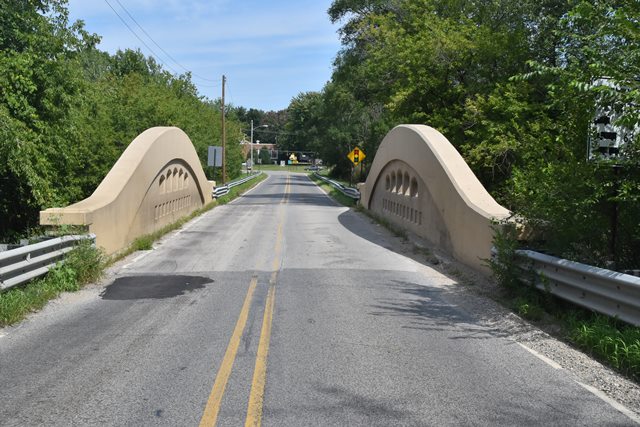
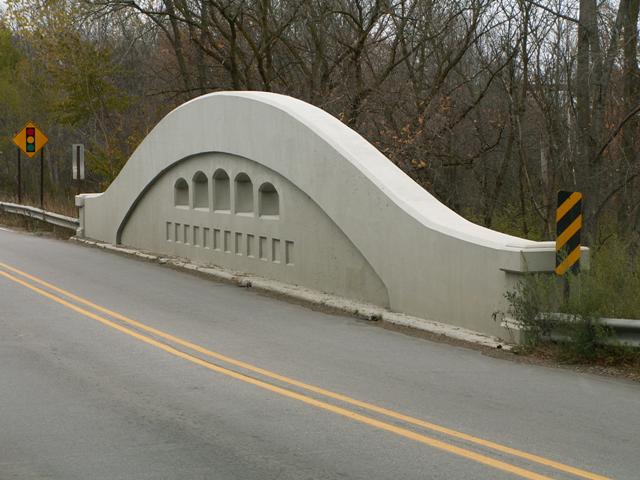
The 7 Mile Road Bridge is located less than a mile from another curved chord through girder, the Irish Street Bridge. Even more odd, is that the Irish Street Bridge is, like this bridge, a 90 foot plan concrete camelback bridge, which is the largest style of this bridge type. It is rare to find two camelbacks of any size so close together. There were once four historic bridges in this one mile area when you include the Sanford Railroad Bridge which is also in this area, as well as the North Saginaw Road Bridge that was moved. The 7 Mile Road Bridge was beautifully restored representing a major benchmark for other counties to follow. Concrete camelback bridges are very rare structures, and beautiful as well, but are not currently receiving the attention they deserve.
As little attention as truss bridges get, concrete curved chord through girder bridges, commonly called concrete camelbacks, are just as deserving of attention. They are unique to Michigan and are found in no other state. Michigan had around 45 left in 1995, and probably has a lot less today. As a result, each remaining example is nationally significant. Despite this, they are commonly demolished due to their narrow two lane widths. Midland County however, acted sensibly to preserve its transportation heritage, and chose to restore this bridge instead. They probably considered that while 7 Mile Road is a well-traveled road, it does not carry tons of heavy, constant traffic, as well as the fact that people should not be going very fast when the cross this bridge, due to a nearby intersection and a curve. The width of this bridge is very appropriate for the road. Midland County did a good job restoring this bridge, as they patched sections that had deteriorated with concrete. As they did this, they made an effort to preserve its historic integrity by ensuring that their patch jobs conformed to the original shape of the bridge. They finalized the restoration with a protective layer of white concrete paint on the girders of the bridge. This will protect the bridge, and also blends the patched areas in with the rest of the bridge. Midland County deserves to be thanked for saving this bridge!
It is too bad that a plaque does not survive on the bridge. Michigan Historic Bridge Inventory gave a 1927 construction date for the bridge.
This bridge is tagged with the following special condition(s): Unorganized Photos


Coordinates (Latitude, Longitude):
Search For Additional Bridge Listings:
Bridgehunter.com: View listed bridges within 0.5 miles (0.8 kilometers) of this bridge.
Bridgehunter.com: View listed bridges within 10 miles (16 kilometers) of this bridge.
Additional Maps:
Google Streetview (If Available)
GeoHack (Additional Links and Coordinates)
Apple Maps (Via DuckDuckGo Search)
Apple Maps (Apple devices only)
Android: Open Location In Your Map or GPS App
Flickr Gallery (Find Nearby Photos)
Wikimedia Commons (Find Nearby Photos)
Directions Via Sygic For Android
Directions Via Sygic For iOS and Android Dolphin Browser
USGS National Map (United States Only)
Historical USGS Topo Maps (United States Only)
Historic Aerials (United States Only)
CalTopo Maps (United States Only)

© Copyright 2003-2024, HistoricBridges.org. All Rights Reserved. Disclaimer: HistoricBridges.org is a volunteer group of private citizens. HistoricBridges.org is NOT a government agency, does not represent or work with any governmental agencies, nor is it in any way associated with any government agency or any non-profit organization. While we strive for accuracy in our factual content, HistoricBridges.org offers no guarantee of accuracy. Information is provided "as is" without warranty of any kind, either expressed or implied. Information could include technical inaccuracies or errors of omission. Opinions and commentary are the opinions of the respective HistoricBridges.org member who made them and do not necessarily represent the views of anyone else, including any outside photographers whose images may appear on the page in which the commentary appears. HistoricBridges.org does not bear any responsibility for any consequences resulting from the use of this or any other HistoricBridges.org information. Owners and users of bridges have the responsibility of correctly following all applicable laws, rules, and regulations, regardless of any HistoricBridges.org information.
