



View Information About HSR Ratings

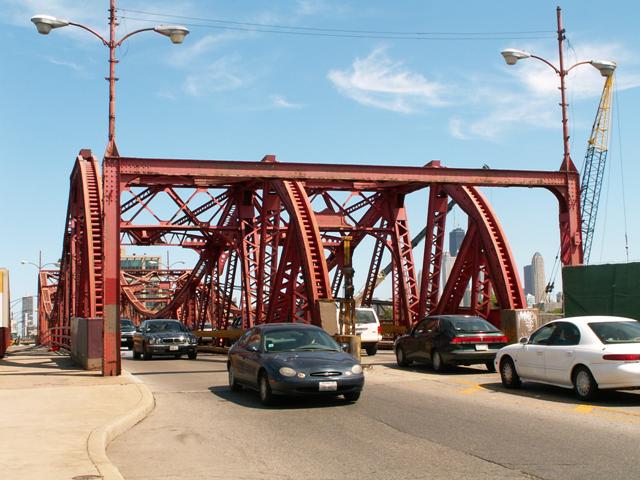
This bridge was one of the most important bascule bridges in the city, since it was an example of a first generation bascule bridge, modeled after the Cortland Street Bridge, the first Chicago type trunnion bascule bridge ever built. The superstructure contractor for the North Avenue Bridge was Roemheld and Gallery. The superstructure contractor for the North Avenue Bridge was Roemheld and Gallery. The substructure contractor was Jackson and Corbett. The American Bridge Company fabricated the bridge. John C. Penn, Assistant Engineer, was the local engineer in charge of the work.
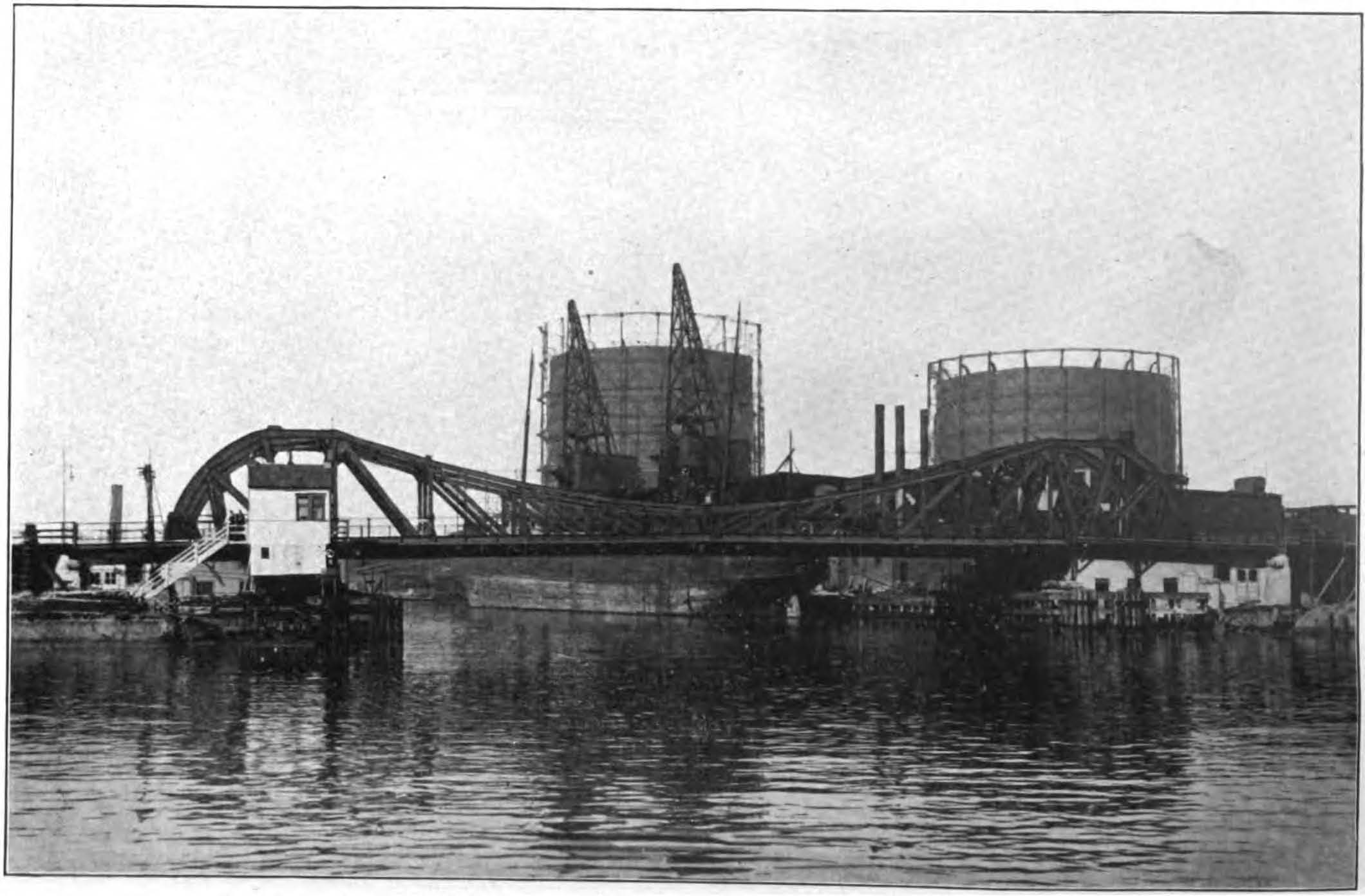
During construction of the bascule bridge, a temporary pontoon bridge was built to carry traffic. Like other pontoon bridges the city once had, the floating bridge could be swung out of the way for boats. This particular pontoon bridge operated by two paddle wheels mounted on the pontoon and driven by electric motor. This operation differed from other pontoon bridges in the city, which were opened by winding a chain around a drum which would pull on the pontoon bridge, causing it to swing open.
The first documented bridge at this location was a hand-turned bridge built of wood in 1865 by N. Chapin and Company. It was rebuilt in 1877 as an iron/wood combination bridge on Conro, Carkin, and Company.
Many bridge enthusiasts know that Chicago is the bascule bridge capital of the world. The bascule bridge type of bridge was developed there, and to this day no other city on the planet has more bascule bridges. Given this, one would think that these bridges in Chicago would be preserved and considered the pride and joy of the city. For the most part, this appears to be the case, with some exceptions. The North Avenue Bridge is one of those exceptions. One of the oldest bascule bridges in the city, and with ornate portal designs and builder plaques, city officials chose to demolish this historic bridge, wiping out a critical part of what makes Chicago the beautiful and prosperous city it is today.
In its place, city officials were excited to be building a "suspension bridge" that they said looks like the Golden Gate Bridge. However, the bridge that was constructed looks absolutely nothing like the Golden Gate Bridge in San Francisco. The new bridge at North Avenue is far smaller and it has cable stays. The tower design is completely different, and the bridge is much more plain looking overall compared to the majestic Golden Gate Bridge. The design Chicago has come up with looks like a half cable-stayed half suspension bridge. A few photos of this replacement bridge can be found at the end of the HistoricBridges.org photo gallery for the bridge. Undoubtedly, the bridge is far more interesting and creative than the typical pre-stressed concrete box beam bridge that forms the structure for most modern crossings. However, was this bridge the appropriate thing for Chicago? A lot of time and design effort probably went into this bridge. Time that would have probably been better spent planning a solution that would have preserved at least some aspects of the historic North Avenue bascule bridge while at the same time meeting the demands of traffic on the road. What could have been done? A new two-lane bridge could have been built next to the historic bridge and the historic bridge restored, forming a one-way couplet where each bridge would serve one-way traffic. Indeed, during construction, a temporary bridge was constructed next to the historic bridge demonstrating that enough land was available for this preservation solution. Alternatively, if complete removal and replacement was determined to be the best option, the trusses of the historic bridge could have been salvaged. The new bridge could have been of a simpler design, and then the trusses could have been placed on the bridge as a decorative enhancement and memorial to the historic bridge. This solution would have at least salvaged some of the original historic bridge material and kept it visible and accessible to the public. Another problem with the replacement bridge is the plaque. The plaque reads "First Erected 1906" and "Reconstructed 2007." While the previous bridge, the historic bascule bridge, was built in 1906, the North Avenue Bridge was "first erected" sometime before that. For example, an 1862 annual report for the city mentions a North Avenue Bridge.
During the construction of this bridge engineers and newspapers kept talking about how this new bridge, in their minds, looks like the Golden Gate Bridge. It was like they were jealous of San Francisco. A great city like Chicago need not be jealous of San Francisco. Chicago should instead seek to continue to embrace the the beauty and heritage of the movable bridges in the city, which define Chicago's historic identity just like San Francisco's Golden Gate Bridge. The North Avenue Bridge was part of what defined Chicago's unique transportation heritage. The North Avenue Bridge was among the oldest bascule bridges in Chicago, and was similar to the oldest, which is Cortland Street Bridge. As evidence of how deep its heritage goes, consider the below photograph from 1907. Look at how different the scene around the bridge then was from what it was today. The entire world changed around the bridge, but the bridge had remained. The North Avenue Bridge was one of the last glimpses of Chicago's heritage at this location.
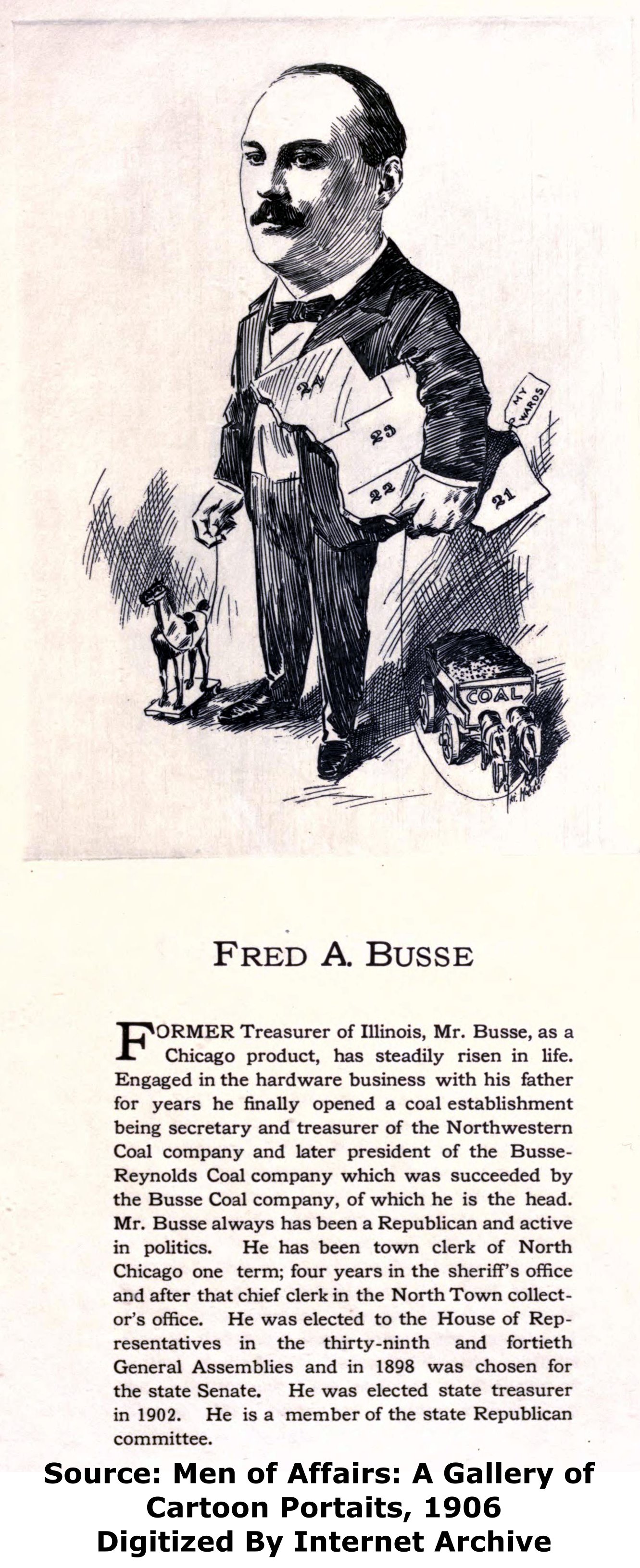
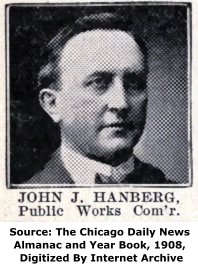
Be sure to view the excerpts from the 1907 annual report of the department of public works. It has an interesting discussion of the bridge. The cartoon to the right and the photo below both show Fred A Busse, who was mayor at the time that this bridge was constructed.


|
City Plaque 1907FRED A BUSSE, MAYOR JOHN J. HANBERG, COMMISSIONER OF PUBLIC WORKS. JOHN ERICSON, CITY ENGINEER. THOS. C. PIHLFELDT, CITY BRIDGE ENGINEER ALEXANDER VON BABO STRUCTURAL DESIGNER. |
Builder Plaque 1906CONTRACTOR FOR SUPERSTRUCTURE ROEMHELD & GALLERY CONSTRACTOR FOR SUBSTRUCTURE JACKSON & CORBETT STEEL WORK BY AMERICAN BRIDGE CO. OF NEW YORK |
Modern Non-Historic Replacement Bridge Plaque NORTH AVENUE BRIDGE
CITY OF CHICAGO RICHARD M. DALEY MAYOR DEPARTMENT OF TRANSPORTATION
DIVISION OF ENGINEERING
|



Chicago and Cook County are home to one of the largest collections of historic bridges in the country, and no other city in the world has more movable bridges. HistoricBridges.org is proud to offer the most extensive coverage of historic Chicago bridges on the Internet.
General Chicago / Cook County Bridge Resources
Chicago's Bridges - By Nathan Holth, author of HistoricBridges.org, this book provides a discussion of the history of Chicago's movable bridges, and includes a virtual tour discussing all movable bridges remaining in Chicago today. Despite this broad coverage, the book is presented in a compact format that is easy to take with you and carry around for reference on a visit to Chicago. The book includes dozens of full color photos. Only $9.95 U.S! ($11.95 Canadian). Order Now Direct From The Publisher! or order on Amazon.
Chicago River Bridges - By Patrick T. McBriarty, this is a great companion to Holth's book shown above. This much larger book offers an extremely in-depth exploration of Chicago's movable highway bridges, including many crossings that have not existed for many years. Order Now Direct From The Publisher! or order on Amazon.
View Historic American Engineering Record (HAER) Overview of Chicago Bascule Bridges (HAER Data Pages, PDF)
Chicago Loop Bridges - Chicago Loop Bridges is another website on the Internet that is a great companion to the HistoricBridges.org coverage of the 18 movable bridges within the Chicago Loop. This website includes additional information such as connections to popular culture, overview discussions and essays about Chicago's movable bridges, additional videos, and current news and events relating to the bridges.
Additional Online Articles and Resources - This page is a large gathering of interesting articles and resources that HistoricBridges.org has uncovered during research, but which were not specific to a particular bridge listing.

This historic bridge has been demolished. This map is shown for reference purposes only.
Coordinates (Latitude, Longitude):
Search For Additional Bridge Listings:
Bridgehunter.com: View listed bridges within 0.5 miles (0.8 kilometers) of this bridge.
Bridgehunter.com: View listed bridges within 10 miles (16 kilometers) of this bridge.
Additional Maps:
Google Streetview (If Available)
GeoHack (Additional Links and Coordinates)
Apple Maps (Via DuckDuckGo Search)
Apple Maps (Apple devices only)
Android: Open Location In Your Map or GPS App
Flickr Gallery (Find Nearby Photos)
Wikimedia Commons (Find Nearby Photos)
Directions Via Sygic For Android
Directions Via Sygic For iOS and Android Dolphin Browser
USGS National Map (United States Only)
Historical USGS Topo Maps (United States Only)
Historic Aerials (United States Only)
CalTopo Maps (United States Only)

© Copyright 2003-2024, HistoricBridges.org. All Rights Reserved. Disclaimer: HistoricBridges.org is a volunteer group of private citizens. HistoricBridges.org is NOT a government agency, does not represent or work with any governmental agencies, nor is it in any way associated with any government agency or any non-profit organization. While we strive for accuracy in our factual content, HistoricBridges.org offers no guarantee of accuracy. Information is provided "as is" without warranty of any kind, either expressed or implied. Information could include technical inaccuracies or errors of omission. Opinions and commentary are the opinions of the respective HistoricBridges.org member who made them and do not necessarily represent the views of anyone else, including any outside photographers whose images may appear on the page in which the commentary appears. HistoricBridges.org does not bear any responsibility for any consequences resulting from the use of this or any other HistoricBridges.org information. Owners and users of bridges have the responsibility of correctly following all applicable laws, rules, and regulations, regardless of any HistoricBridges.org information.
