



View Information About HSR Ratings

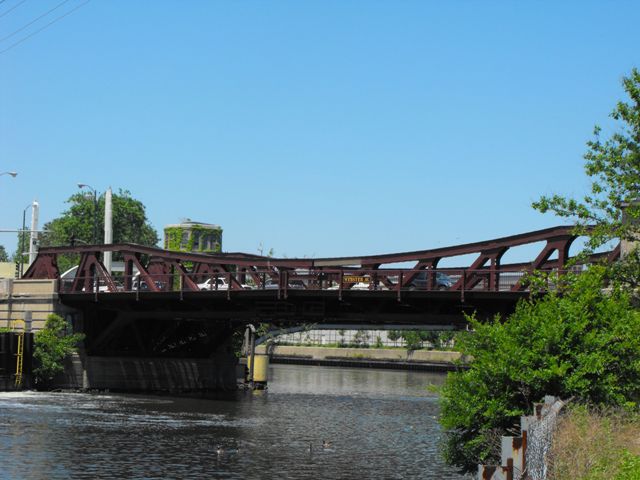
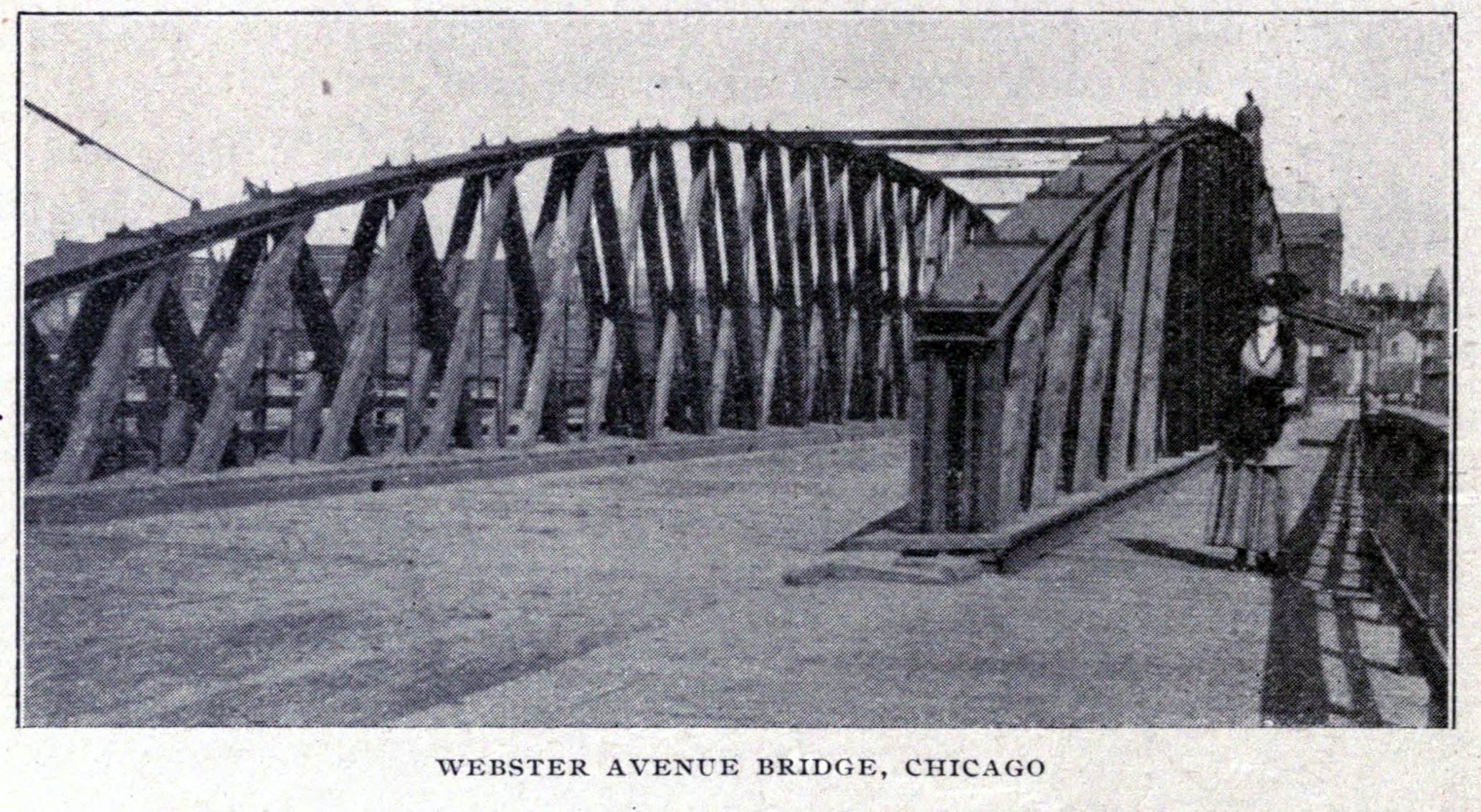
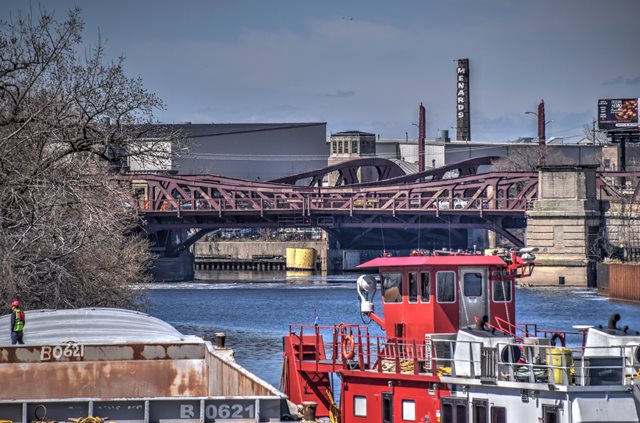
The Webster Avenue Bridge is an example of the oldest style of pony bascule bridge in Chicago. It displays the less smooth curve to its trusses. Neighboring Ashland Avenue Bridge, with its second generation design featuring smooth truss curves is a good contrast.
This bridge is a member of the greatest collection of historic bascule bridges on the planet, which is located in the city Chicago and Cook County. The fact that Chicago is a city with such a large, record-breaking number of bascule bridges, and most of them considered historic, is something the city should be truly proud of. For the most part, Chicago has been a model for historic bridge preservation, especially with the bridges in the downtown area. They have chosen to maintain, and rehabilitate as needed, their historic bridges for the continuous heavy traffic one might expect in the nation's third largest city. The fact that so many of these bridges remain functional and historically intact as well sends a message to other cities and even rural locations who claim that historic bridges cannot serve the needs of modern day traffic.

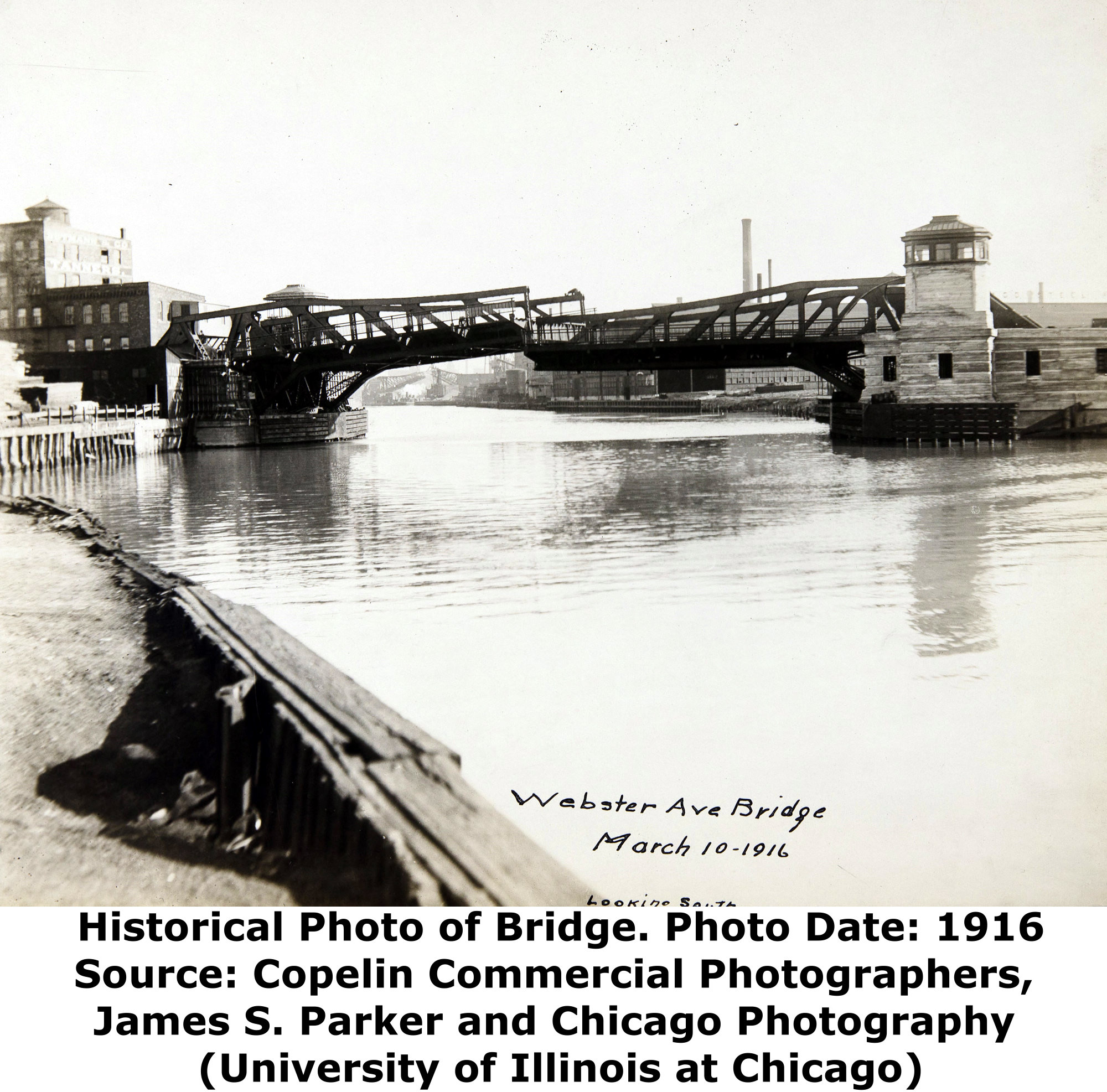
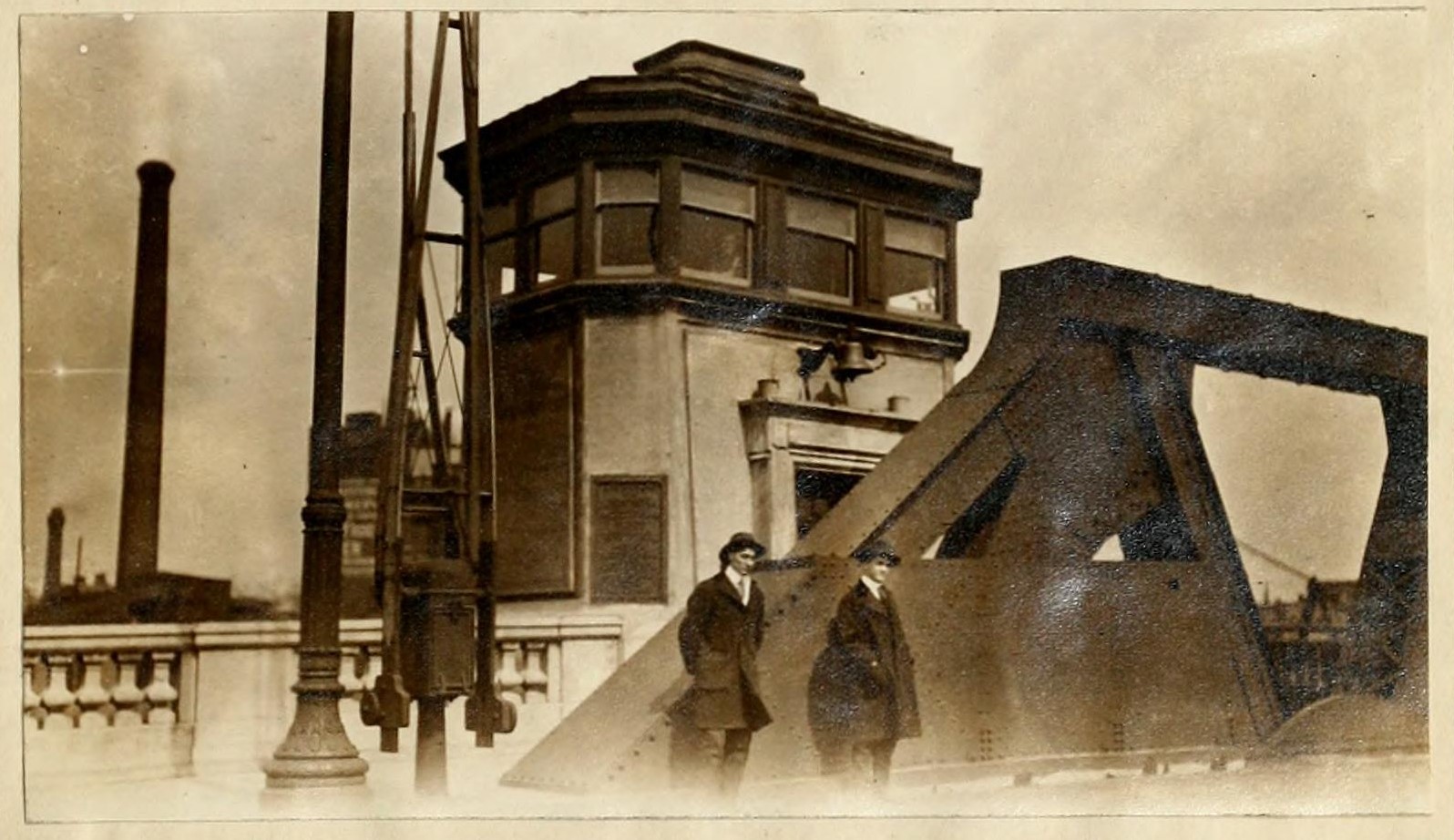
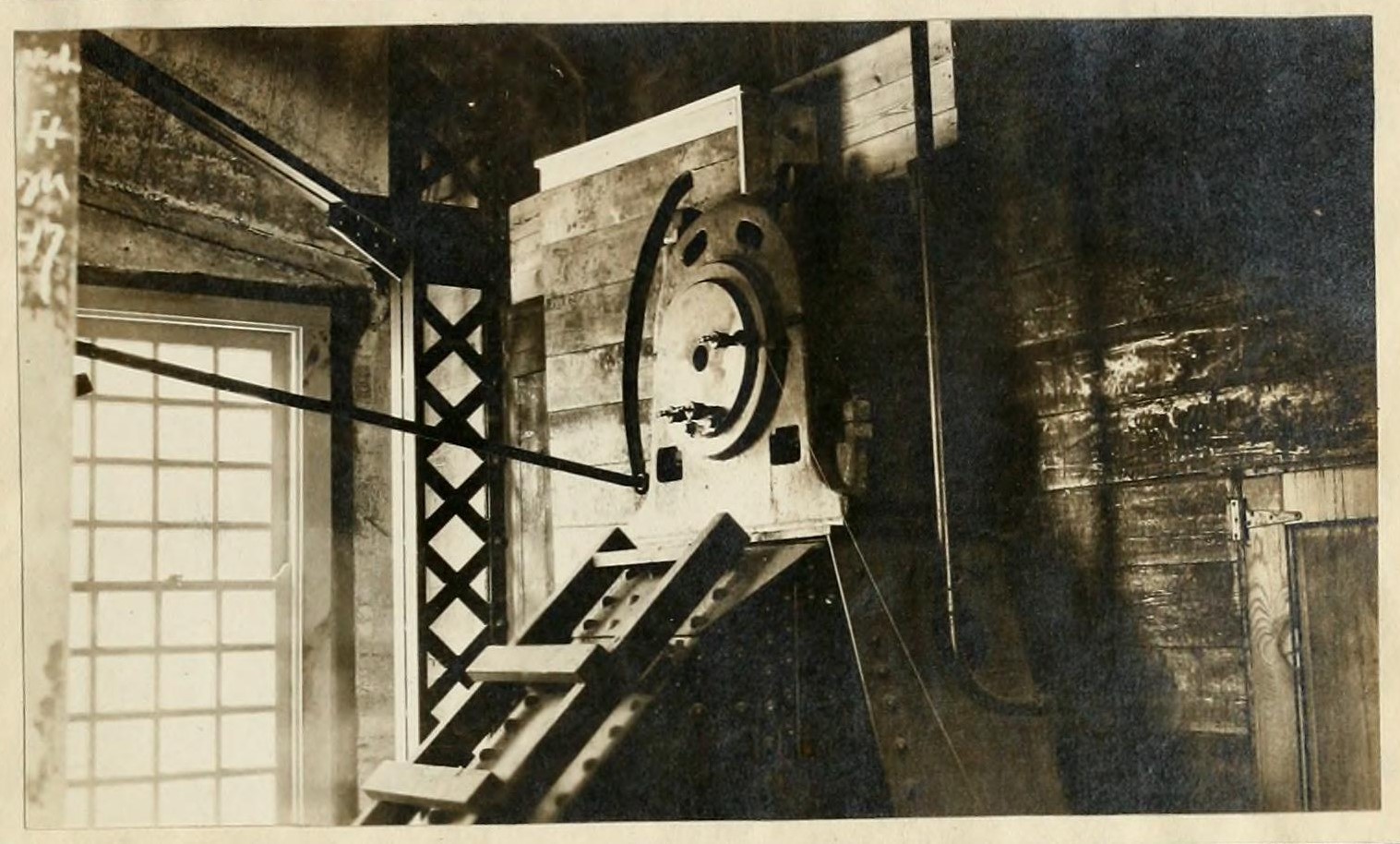
A historical thesis paper written about tests students did on the bridge includes a photo where a C. H. Norwood plaque is visible on the electrical equipment indicating that this firm was the electrical contractor for the bridge. Also shown in this paper are photos showing the original bridge tender houses, which have since been severely altered. The superstructure contractor for the bridge was Ketler-Elliott Company of Chicago, Illinois and the substructure contractor was Great Lakes Dredge and Dock Company of Chicago, Illinois.
The previous bridge at this location (also the first documented bridge at this location) was a wooden through truss swing bridge. It was an iron/wood combination hand-turned swing bridge that was built in 1872 to carry Clark Street over the Main Branch, by Fox and Howard. In 1889, it was moved and reused as a bridge at Webster Avenue. as a The design appears to have been similar to some of the other long-gone bridges on this section of the river, many of which were also built by Fox and Howard.
While Chicago is a leader in historic bridge preservation downtown, how do the city's historic bridges fare out away from the core of the city? Their conditions vary widely, some remain in excellent condition, while others show need of rehabilitation. How does the city's commitment to preservation stand outside of the downtown? This remains to be seen for certain, with initial evidence pointing in both directions. Certainly, nearby Cortland Street Bridge displays a commitment to preservation, having been continuously maintained and preserved the past few years. However, it is worth noting that Ashland Avenue Bridge was not always the northernmost historic movable highway bridge in Chicago. Nearby Damen Avenue Bridge to the north was demolished and replaced with a modern through arch that, while more attractive than a normal modern bridge, does not convey Chicago's movable bridge or industrial heritage, and does not blend into the context of Chicago bridges or the canalized river in which they cross. It is impossible to make a connection to Chicago's past, or the canal's past with this new bridge.
Many of the movable bridges on the North Branch and South Branch (Sanitary Canal) of Chicago River are unlike those on the main branch and downtown Chicago. In addition, some of the oldest and most historic bascule bridges are on the North Branch. It is essential that these outlying bridges be preserved alongside the core downtown movable bridges. Moving forward, if Chicago wishes to maintain its image as the worldwide capital of bascule bridges, and if it also wishes to maintain its image as one of this nation's great Historic Bridge Cities alongside cities like Pittsburgh, a long-term preservation plan for its remaining historic bascule bridges should be put in place, especially for these bridges that sit outside of the downtown loop.
As of 2014, Chicago Department of Transportation is reportedly making plans to rehabilitate this bridge. The work would include replacement of lateral bracing, deck stringers, and floor beams. The deck would be replaced with a solid concrete deck and trusses would be strengthened to accommodate the heavier deck. Reportedly, everything remaining of the bridge tender houses above the deck will be demolished, but everything below the deck level from the bridge tender houses would remain. If plans move forward, the work could begin as soon as Fall 2014.





Chicago and Cook County are home to one of the largest collections of historic bridges in the country, and no other city in the world has more movable bridges. HistoricBridges.org is proud to offer the most extensive coverage of historic Chicago bridges on the Internet.
General Chicago / Cook County Bridge Resources
Chicago's Bridges - By Nathan Holth, author of HistoricBridges.org, this book provides a discussion of the history of Chicago's movable bridges, and includes a virtual tour discussing all movable bridges remaining in Chicago today. Despite this broad coverage, the book is presented in a compact format that is easy to take with you and carry around for reference on a visit to Chicago. The book includes dozens of full color photos. Only $9.95 U.S! ($11.95 Canadian). Order Now Direct From The Publisher! or order on Amazon.
Chicago River Bridges - By Patrick T. McBriarty, this is a great companion to Holth's book shown above. This much larger book offers an extremely in-depth exploration of Chicago's movable highway bridges, including many crossings that have not existed for many years. Order Now Direct From The Publisher! or order on Amazon.
View Historic American Engineering Record (HAER) Overview of Chicago Bascule Bridges (HAER Data Pages, PDF)
Chicago Loop Bridges - Chicago Loop Bridges is another website on the Internet that is a great companion to the HistoricBridges.org coverage of the 18 movable bridges within the Chicago Loop. This website includes additional information such as connections to popular culture, overview discussions and essays about Chicago's movable bridges, additional videos, and current news and events relating to the bridges.
Additional Online Articles and Resources - This page is a large gathering of interesting articles and resources that HistoricBridges.org has uncovered during research, but which were not specific to a particular bridge listing.
This bridge is tagged with the following special condition(s): Unorganized Photos


Coordinates (Latitude, Longitude):
Search For Additional Bridge Listings:
Bridgehunter.com: View listed bridges within 0.5 miles (0.8 kilometers) of this bridge.
Bridgehunter.com: View listed bridges within 10 miles (16 kilometers) of this bridge.
Additional Maps:
Google Streetview (If Available)
GeoHack (Additional Links and Coordinates)
Apple Maps (Via DuckDuckGo Search)
Apple Maps (Apple devices only)
Android: Open Location In Your Map or GPS App
Flickr Gallery (Find Nearby Photos)
Wikimedia Commons (Find Nearby Photos)
Directions Via Sygic For Android
Directions Via Sygic For iOS and Android Dolphin Browser
USGS National Map (United States Only)
Historical USGS Topo Maps (United States Only)
Historic Aerials (United States Only)
CalTopo Maps (United States Only)

© Copyright 2003-2024, HistoricBridges.org. All Rights Reserved. Disclaimer: HistoricBridges.org is a volunteer group of private citizens. HistoricBridges.org is NOT a government agency, does not represent or work with any governmental agencies, nor is it in any way associated with any government agency or any non-profit organization. While we strive for accuracy in our factual content, HistoricBridges.org offers no guarantee of accuracy. Information is provided "as is" without warranty of any kind, either expressed or implied. Information could include technical inaccuracies or errors of omission. Opinions and commentary are the opinions of the respective HistoricBridges.org member who made them and do not necessarily represent the views of anyone else, including any outside photographers whose images may appear on the page in which the commentary appears. HistoricBridges.org does not bear any responsibility for any consequences resulting from the use of this or any other HistoricBridges.org information. Owners and users of bridges have the responsibility of correctly following all applicable laws, rules, and regulations, regardless of any HistoricBridges.org information.
