



View Information About HSR Ratings
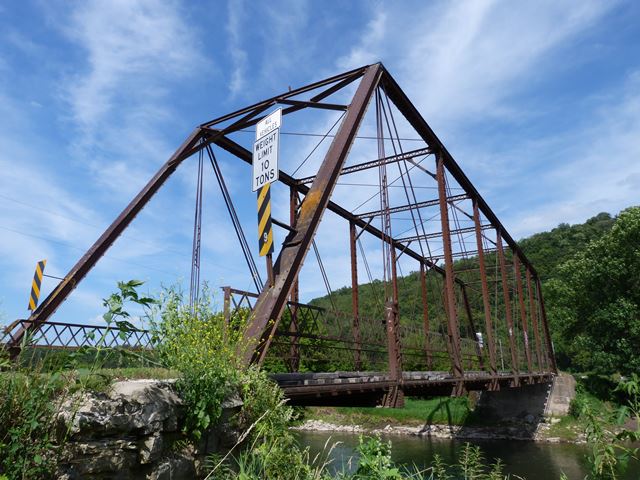
This eight panel bridge is a traditionally composed example of a bridge type that was in its time the most common type of bridge built, but is today becoming rare at a rapid rate due to demolition. The 1911 bridge is noteworthy because it is what the mainstream of bridge design at the end of the pin-connected truss era. With no usual or distinctive details it provides a clear example of what an "average" bridge of this period would have looked like. In our efforts to single out rare and unusual historic bridges, it is important to also preserve some of these more "normal" historic bridges, in order to retain a clear physical record of bridge construction in that period of history.
This bridge retains fair historic integrity. The bridge has been altered by the addition of cables, however original bridge material does not appear to have been removed or harmed, with the exception of holes created to feed the cables through.
The bridge includes a detail that appears on a number of pin-connected truss bridges, but is still worthy of mention, which is a segmented hip vertical, with the top three quarters being an eye bar, and the bottom quarter being a built-up beam, and an intermediate pin connection to connect these two parts. Hip verticals are the black sheep in a Pratt truss, since they tend to be in tension rather than in compression like the rest of the vertical members, so often eye bars were used at the hip vertical instead of the built up beams usually used on the other vertical members. This however presented a problem for bridge builders, since with an eyebar hip vertical and the inherent slim profile of an eyebar, it was difficult to attach the railing at the hip vertical. On a traditional built-up beam vertical with back-to-back channels connected by lacing or lattice, the railing would simply be bolted or riveted on. However, this was not possible to do with an eyebar. Solutions for attaching railings to these troublesome hip verticals varied, but one solution was to run a built-up beam on the hip vertical up from the bottom chord just far enough to provide a railing attachment, and then run the eyebar for the rest of the distance to the top chord. The Henry bridge is an example of this solution.



This historic bridge has been demolished. This map is shown for reference purposes only.
Coordinates (Latitude, Longitude):
Search For Additional Bridge Listings:
Bridgehunter.com: View listed bridges within 0.5 miles (0.8 kilometers) of this bridge.
Bridgehunter.com: View listed bridges within 10 miles (16 kilometers) of this bridge.
Additional Maps:
Google Streetview (If Available)
GeoHack (Additional Links and Coordinates)
Apple Maps (Via DuckDuckGo Search)
Apple Maps (Apple devices only)
Android: Open Location In Your Map or GPS App
Flickr Gallery (Find Nearby Photos)
Wikimedia Commons (Find Nearby Photos)
Directions Via Sygic For Android
Directions Via Sygic For iOS and Android Dolphin Browser
USGS National Map (United States Only)
Historical USGS Topo Maps (United States Only)
Historic Aerials (United States Only)
CalTopo Maps (United States Only)

© Copyright 2003-2024, HistoricBridges.org. All Rights Reserved. Disclaimer: HistoricBridges.org is a volunteer group of private citizens. HistoricBridges.org is NOT a government agency, does not represent or work with any governmental agencies, nor is it in any way associated with any government agency or any non-profit organization. While we strive for accuracy in our factual content, HistoricBridges.org offers no guarantee of accuracy. Information is provided "as is" without warranty of any kind, either expressed or implied. Information could include technical inaccuracies or errors of omission. Opinions and commentary are the opinions of the respective HistoricBridges.org member who made them and do not necessarily represent the views of anyone else, including any outside photographers whose images may appear on the page in which the commentary appears. HistoricBridges.org does not bear any responsibility for any consequences resulting from the use of this or any other HistoricBridges.org information. Owners and users of bridges have the responsibility of correctly following all applicable laws, rules, and regulations, regardless of any HistoricBridges.org information.
