



View Information About HSR Ratings
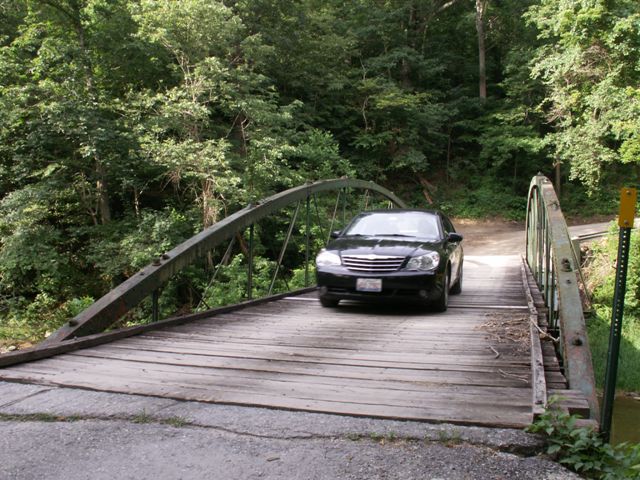
Motor vehicles were not even a thought when this bridge was built, yet so well-built was this bridges that 130 years later Bennies Hill Road Bridge continues to safely carry vehicles it was not even designed for. With a rehabilitation project underway, it will be able to continue to do so for decades to come.
This bridge is among the most important bridges in the county, and even the state. As a textbook example of a King Bridge Company bowstring with good historic integrity, the bridge documents one company's approach to bridge design early in the metal truss era. This bridge was being rehabilitated in 2009. Photos on this site are taken prior to this project.
As mentioned, the bridge has extremely high integrity of design and materials. There are some alterations however. The western abutment was replaced in 1977, while the original stone abutment remains on the eastern side. Also in 1977 deck stringers were replaced. In 1993, additional work was done on the bridge. As of 2008 original floorbeams appeared to remain on the bridge. Hopefully the 2009 rehabilitation retained these important and unusual parts of the bridge. One nice thing is that it will be able to continue to carry vehicles; most restored bowstrings end up serving as pedestrian-only bridges. It is truly a thrill to be able to drive on an iron bridge that is over 130 years old.
The bridge is a ten panel bowstring truss bridge, built to the distinctive design that the King Bridge Company used for its bowstring bridges. Bowstring bridges, having been built early in the truss era before standardization, are easy to associate with builders because each company had its own very unique design. Furthermore, a plaque survives on the Bennies Hill Road Bridge confirming the builder.
The Bennies Hill Road Bridge is an extremely important structure because with good integrity, it documents King Bridge Company's patented bridge design very well. The design uses rolled star iron (also called cruciform) members for verticals and outriggers. The top chord is a built-up box. Connections on the bridge are made in the form of single bolts which attach to the threaded, rod-shaped ends of members. The bottom chord is an unusual assembly of plates that are appear to be bolted together at the ends of each manufactured segment. The rolled American Standard Beam floorbeams are interesting because they are not connected directly to the vertical member. Instead, they actually rest on the bottom chord, which is in turn connected to the vertical. Rather than one floorbeam at each panel point, there is instead two floorbeams, one on either side of the vertical. This means the weight/stress appears to transfer from the vertical to the floorbeams through a short portion of this bottom chord on either side of the vertical. Furthermore, on panel points where outriggers are present, a third floorbeam is present to hold the outriggers.


Coordinates (Latitude, Longitude):
Search For Additional Bridge Listings:
Bridgehunter.com: View listed bridges within 0.5 miles (0.8 kilometers) of this bridge.
Bridgehunter.com: View listed bridges within 10 miles (16 kilometers) of this bridge.
Additional Maps:
Google Streetview (If Available)
GeoHack (Additional Links and Coordinates)
Apple Maps (Via DuckDuckGo Search)
Apple Maps (Apple devices only)
Android: Open Location In Your Map or GPS App
Flickr Gallery (Find Nearby Photos)
Wikimedia Commons (Find Nearby Photos)
Directions Via Sygic For Android
Directions Via Sygic For iOS and Android Dolphin Browser
USGS National Map (United States Only)
Historical USGS Topo Maps (United States Only)
Historic Aerials (United States Only)
CalTopo Maps (United States Only)

© Copyright 2003-2024, HistoricBridges.org. All Rights Reserved. Disclaimer: HistoricBridges.org is a volunteer group of private citizens. HistoricBridges.org is NOT a government agency, does not represent or work with any governmental agencies, nor is it in any way associated with any government agency or any non-profit organization. While we strive for accuracy in our factual content, HistoricBridges.org offers no guarantee of accuracy. Information is provided "as is" without warranty of any kind, either expressed or implied. Information could include technical inaccuracies or errors of omission. Opinions and commentary are the opinions of the respective HistoricBridges.org member who made them and do not necessarily represent the views of anyone else, including any outside photographers whose images may appear on the page in which the commentary appears. HistoricBridges.org does not bear any responsibility for any consequences resulting from the use of this or any other HistoricBridges.org information. Owners and users of bridges have the responsibility of correctly following all applicable laws, rules, and regulations, regardless of any HistoricBridges.org information.
