



View Information About HSR Ratings
Additional History: This bridge was constructed in 1932 by the State Highway Department as a future 4-lane highway for M-39. M-39 was planned to be the state highway connecting Grand Rapids to Hastings and Battle Creek to the south and Lansing to the east. By the late 1930's, the Department had abandoned M-39 and returned the jurisdiction of the road and bridge to Kent County Road Commission.
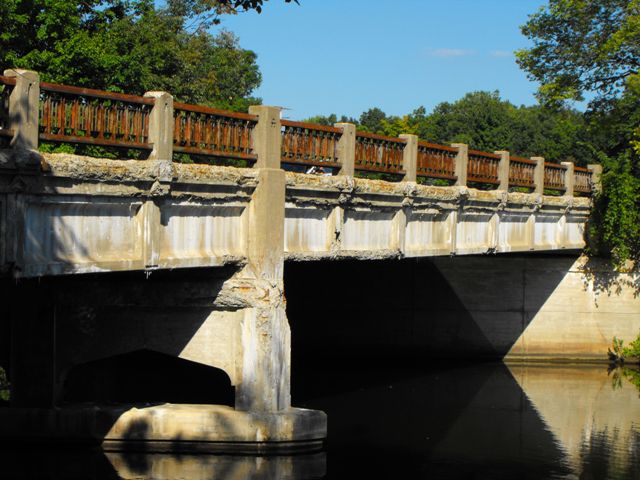
This bridge appears to be one of Michigan's most important metal stringer bridges, although the historic bridge inventory apparently did not recognize its significance. This appears to be one of the oldest examples of a bridge with original R4 railings in the state, and is also an example of a bridge which was either a transitional bridge or a prototype bridge as the state highway department moved from one standard plan to a new standard plan for stringer bridges. The old plan included stringers with a unique concrete balustrade design and a concrete facade over the outermost stringer to give the bridge an overall appearance of a concrete bridge when it was in face a steel stringer. This plan was abandoned for the new plan which did not include the concrete facade on any beams, and began the use of R4 railings. Most of the other earliest instances of bridges with original R4 railings on them are dated to around 1935, while the last of the concrete facade and balustrade stringers date to 1932 or earlier. The 108th Avenue Bridge, with a construction date of 1932, features the R4 railings, but also features the general pier design and concrete facade seen in the concrete balustrade plan bridges of the late 1920s and early 1930s. The R4 railings on 108th Avenue were determined to be original (and not a later alteration/addition) because the inset design on their concrete railing is the oldest design. If the railings were not original they would have more than likely featured the more common keyhole design on the concrete railing posts. In addition no alteration to the bridge is recorded or was observed during on-site inspection.
As such, the 108th Avenue Bridge appears to be an extremely rare bridge which shows a transition from a bridge like Cleveland Avenue Bridge to bridges like the US-41 Sturgeon River Bridge.
R4 railings are the decorative railings that would give the gift of beauty to Michigan stringer bridges until the 1960s. For roughly 30 years, Michigan used these railing panels, fitted between railing post designs that varied over time and from bridge to bridge between a few different styles. The R4 railing has defined much of Michigan's 20th century historic bridges.


This historic bridge has been demolished. This map is shown for reference purposes only.
Coordinates (Latitude, Longitude):
Search For Additional Bridge Listings:
Bridgehunter.com: View listed bridges within 0.5 miles (0.8 kilometers) of this bridge.
Bridgehunter.com: View listed bridges within 10 miles (16 kilometers) of this bridge.
Additional Maps:
Google Streetview (If Available)
GeoHack (Additional Links and Coordinates)
Apple Maps (Via DuckDuckGo Search)
Apple Maps (Apple devices only)
Android: Open Location In Your Map or GPS App
Flickr Gallery (Find Nearby Photos)
Wikimedia Commons (Find Nearby Photos)
Directions Via Sygic For Android
Directions Via Sygic For iOS and Android Dolphin Browser
USGS National Map (United States Only)
Historical USGS Topo Maps (United States Only)
Historic Aerials (United States Only)
CalTopo Maps (United States Only)

© Copyright 2003-2024, HistoricBridges.org. All Rights Reserved. Disclaimer: HistoricBridges.org is a volunteer group of private citizens. HistoricBridges.org is NOT a government agency, does not represent or work with any governmental agencies, nor is it in any way associated with any government agency or any non-profit organization. While we strive for accuracy in our factual content, HistoricBridges.org offers no guarantee of accuracy. Information is provided "as is" without warranty of any kind, either expressed or implied. Information could include technical inaccuracies or errors of omission. Opinions and commentary are the opinions of the respective HistoricBridges.org member who made them and do not necessarily represent the views of anyone else, including any outside photographers whose images may appear on the page in which the commentary appears. HistoricBridges.org does not bear any responsibility for any consequences resulting from the use of this or any other HistoricBridges.org information. Owners and users of bridges have the responsibility of correctly following all applicable laws, rules, and regulations, regardless of any HistoricBridges.org information.
