



View Information About HSR Ratings
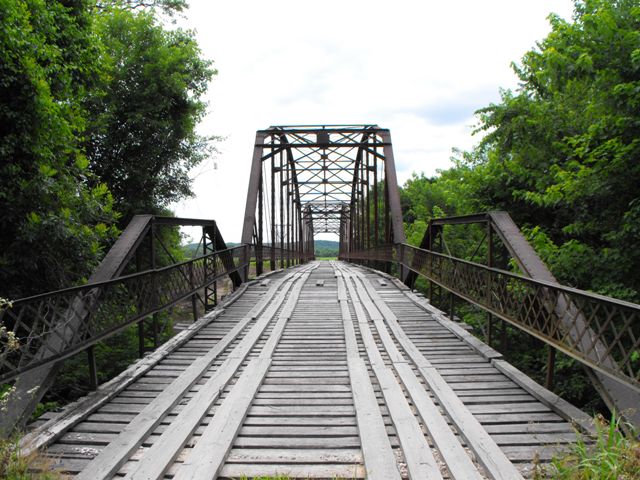
This bridge is an extremely significant structure as a large, multi-span pin-connected truss bridge built by a noted regional bridge builder. It contains two impressive Parker truss main spans. This bridge also contains three approach spans. At the eastern end of the bridge, there are two girder and floorbeam (deck plate girder) spans. They are small spans and the girders are rolled beams. At the western end of the bridge there is something extremely rare and noteworthy, a Queenpost truss.
The bridge retains excellent historic integrity including original lattice railings, wooden deck, and an unaltered truss structure. The truss bridge includes caisson piers.
There used to be many more truss bridges like this one in Missouri, but they have mostly been demolished. While a few others do still remain, the number surviving is extremely small. Among the surviving examples, this bridge stands out as a long example with excellent historic integrity. Whether it is preserved for continued use or bypassed by a modern bridge, this bridge must not be destroyed.
Matt Kuehnert contacted HistoricBridges.org and provided some insight in the bridge's name. His great grandfather was Frederick Dick who owned a farm near Boonville. His father was Peter Dick, who owned nearby Dick's Mill with his brother Adolph after the civil war.

Above: Historical photo of bridge, courtesy Matt Kuehnert
Information and Findings From Missouri's Historic Bridge InventoryBridge Features Superstructure: steel, 8-panel, pin-connected Parker
through trusses; one 50-foot, 3-panel, pin-connected Pratt pony truss
approach span at west end and three steel stringer approach spans at
east end Substructure: concrete abutments and wingwalls with
concrete-filled steel cylinder piers Discussion of Bridge In May 1907, the Cooper County Court conditionally announced that it would rebuild the Dicks Bridge if the local citizenry would pay for one-half its estimated cost. Located over the Lamine River some three miles southeast of Blackwater, the existing structure here had deteriorated beyond the point of repair. County road and bridge commissioner, E.T. Hale, presented the following month his estimate of $6000.00 to construct the Dicks Bridge. He noted that the previous bridge's masonry abutments and steel cylinder piers were largely salvageable, but would need to be elevated approximately four feet. Competitive bids for the reconstruction project were received on August 5, 1907. The Kansas City Bridge Company of Missouri, a prominent contractor in Cooper County, was awarded the contract for this and other structures, totaling $49,600.00. To the discouragement of the county court, local citizens eventually only met a fraction of this amount. The contract for improving the existing abutments was awarded in November to Charles Hutchinson for $5.75 per cubic yard. Hutchinson also handled the re-erection of several piers which had collapsed or were missing. Completed in early May the next year, the Dicks Bridge, a pin-connected Parker through truss, continues to retain a strong degree of visual integrity. As one of Missouri's most prolific bridge fabricators, the Kansas City Bridge Company maintained an extensive catalogue of truss types, ranging from the exotic to the commonplace. KCBCo, like most of the region's bridge builders of the time, relied heavily on pin-connected Pratt truss variants for its standard truss types. After the turn of the century, however, KCBCo began fabricating polygonal-chorded Pratt variants (particularly Parkers) for long-span applications. Their relatively long spans, light structural members and archaic detailing have rendered pin-connected Parker trusses particularly vulnerable to subsequent replacement. As a result, of the hundreds that once carried vehicular traffic throughout the state, fewer than three dozen remain in place today. These range in span length from 110 feet to 200 feet and in erection date from 1900 to 1932. The Dicks Bridge, with its 160-foot span and 1908 construction date, falls within the mainstream of this trend. It is noteworthy for its excellent state of preservation and its two-span configuration. Bridge Considered Historic By Survey: Yes |


Coordinates (Latitude, Longitude):
Search For Additional Bridge Listings:
Bridgehunter.com: View listed bridges within 0.5 miles (0.8 kilometers) of this bridge.
Bridgehunter.com: View listed bridges within 10 miles (16 kilometers) of this bridge.
Additional Maps:
Google Streetview (If Available)
GeoHack (Additional Links and Coordinates)
Apple Maps (Via DuckDuckGo Search)
Apple Maps (Apple devices only)
Android: Open Location In Your Map or GPS App
Flickr Gallery (Find Nearby Photos)
Wikimedia Commons (Find Nearby Photos)
Directions Via Sygic For Android
Directions Via Sygic For iOS and Android Dolphin Browser
USGS National Map (United States Only)
Historical USGS Topo Maps (United States Only)
Historic Aerials (United States Only)
CalTopo Maps (United States Only)

© Copyright 2003-2024, HistoricBridges.org. All Rights Reserved. Disclaimer: HistoricBridges.org is a volunteer group of private citizens. HistoricBridges.org is NOT a government agency, does not represent or work with any governmental agencies, nor is it in any way associated with any government agency or any non-profit organization. While we strive for accuracy in our factual content, HistoricBridges.org offers no guarantee of accuracy. Information is provided "as is" without warranty of any kind, either expressed or implied. Information could include technical inaccuracies or errors of omission. Opinions and commentary are the opinions of the respective HistoricBridges.org member who made them and do not necessarily represent the views of anyone else, including any outside photographers whose images may appear on the page in which the commentary appears. HistoricBridges.org does not bear any responsibility for any consequences resulting from the use of this or any other HistoricBridges.org information. Owners and users of bridges have the responsibility of correctly following all applicable laws, rules, and regulations, regardless of any HistoricBridges.org information.
