



View Information About HSR Ratings
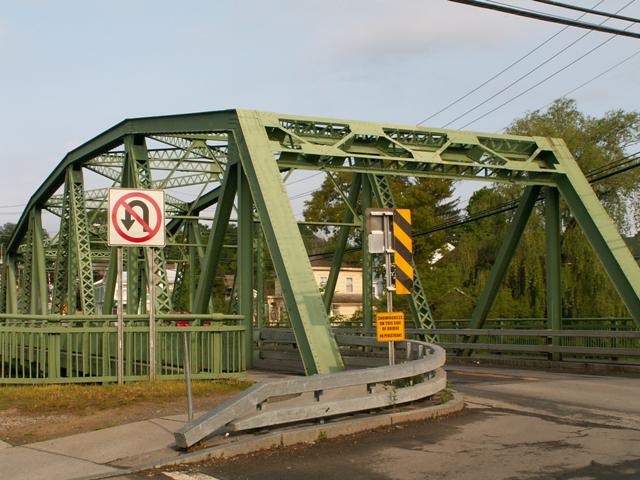
The state of New York, like neighboring Pennsylvania, continued to rely on the metal truss bridge into the first third of the 20th Century, developing a standard plan for metal truss bridges and building them with moderate frequency. Unlike Pennsylvania, which went with the Pratt and Parker truss configurations, New York engineers instead went with the Warren and Warren Polygonal truss configurations. A number of these structures survive today in New York. They all feature riveted connections and "massive" members and have what would have been at the time a relatively wide deck width. Today in the 21st century, the continuity from the standard plan design is psychologically enhanced by the fact that nearly all of these bridges in New York are painted in the same green color. Despite the fact that they are late examples of truss bridge construction, and a relatively fair number remain, they still represent a structure type no longer built today, and are also highly attractive structures that make crossing a bridge something to notice and enjoy. They are also, if properly maintained, strong bridges that are more than capable of serving modern traffic needs safely and efficiently. For all these reasons, the maintenance and preservation of these structures makes sense for fiscal reasons, but also for the greater purpose of preserving these attractive structures, which offer a window into past forms of fabrication, construction, and engineering.
Stone abutments from a previous bridge are immediately next to the Marathon bridge. There is also a section of lattice railing attached to the end of this bridge next to a house that may be from this previous bridge.


Coordinates (Latitude, Longitude):
Search For Additional Bridge Listings:
Bridgehunter.com: View listed bridges within 0.5 miles (0.8 kilometers) of this bridge.
Bridgehunter.com: View listed bridges within 10 miles (16 kilometers) of this bridge.
Additional Maps:
Google Streetview (If Available)
GeoHack (Additional Links and Coordinates)
Apple Maps (Via DuckDuckGo Search)
Apple Maps (Apple devices only)
Android: Open Location In Your Map or GPS App
Flickr Gallery (Find Nearby Photos)
Wikimedia Commons (Find Nearby Photos)
Directions Via Sygic For Android
Directions Via Sygic For iOS and Android Dolphin Browser
USGS National Map (United States Only)
Historical USGS Topo Maps (United States Only)
Historic Aerials (United States Only)
CalTopo Maps (United States Only)

© Copyright 2003-2024, HistoricBridges.org. All Rights Reserved. Disclaimer: HistoricBridges.org is a volunteer group of private citizens. HistoricBridges.org is NOT a government agency, does not represent or work with any governmental agencies, nor is it in any way associated with any government agency or any non-profit organization. While we strive for accuracy in our factual content, HistoricBridges.org offers no guarantee of accuracy. Information is provided "as is" without warranty of any kind, either expressed or implied. Information could include technical inaccuracies or errors of omission. Opinions and commentary are the opinions of the respective HistoricBridges.org member who made them and do not necessarily represent the views of anyone else, including any outside photographers whose images may appear on the page in which the commentary appears. HistoricBridges.org does not bear any responsibility for any consequences resulting from the use of this or any other HistoricBridges.org information. Owners and users of bridges have the responsibility of correctly following all applicable laws, rules, and regulations, regardless of any HistoricBridges.org information.
