



View Information About HSR Ratings
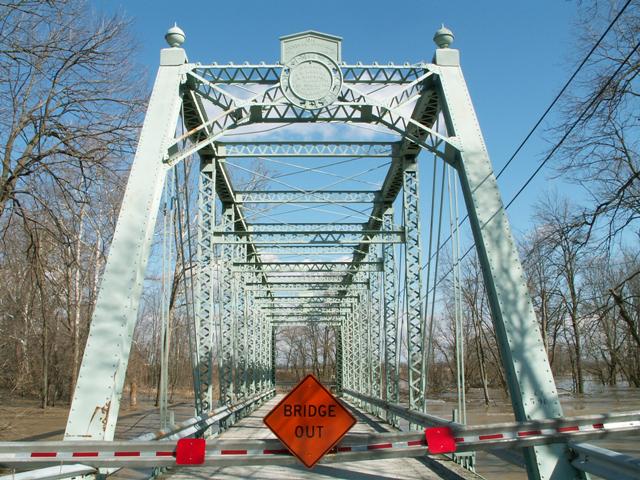
The Clark Road Bridge is a beautiful example of an unusual anomaly in Ohio. By 1916, the pin-connected truss bridge was well on its way to becoming a thing of the past. One would expect to see riveted connections on a structure like the Clark Road Bridge. In addition, this bridge features extremely ornate design of this bridge, which included two decorative builder plaques, finials, and (today missing) further decoration mounted on top of the portal bracing. This type of decoration is more in line with truss bridges of the 1880s. By the early 20th century, the focus in metal truss construction was not longer on adding decorative elements to the bridge.
This bridge was graciously restored by Marion County in 1990. The restoration was done quite well, retaining the historic integrity on the bridge, and providing a durable coat of paint. However, recently, some motorist crashed into the bridge, damaging the bridge to the point that it had to be closed to all traffic. The fate of the bridge is now in question, and demolition is among the possible outcomes. For historic bridge enthusiasts this is a very frustrating situation. Not only might the bridge be lost, but this event might discourage future restorations as well. After all, Marion County put all this money into restoring the bridge, and now this costly event has occurred. Hopefully Marion County will decide to give motorists one more chance, and repair the damage. There may be solutions such as changes in the layout of guardrails that might better protect the bridge from out-of-control drivers.
People crossing historic bridges, particularly metal truss bridges are asked to do so with care and respect. These structures have stood the test of time and will continue to do so if used properly by those who cross them. Always cross a one-lane metal truss bridge at a very slow speed. Yield or stop before you cross the bridge and ensure that there is no other cars attempting to cross the bridge. In most cases, if another car is waiting, you should treat the bridge as a four-way stop. Examine the deck as you approach the bridge to check for ice or other hazards. It is important to show highway agencies that we are responsible drivers and do not need ugly modern bridges with shoulders as wide as the lanes themselves to cross safely. Even if you do not care for historic bridges, you should drive carefully because you don't want to wreck your car, nor do you want the inconvenience of a detour if you damage the bridge and it is closed to traffic. It is the opinion of this website that anyone who damages a historic bridge is completely at fault, and any motorist-caused damage is likely caused due to crossing either over the posted weight limit or crossing too fast for conditions, whether those conditions be weather, width of bridge, or alignment of bridge. Future legislation should enact financial penalties, perhaps calling on the motorist's insurance, for anyone who damages a historic bridge, which would in turn be used to repair any damage caused.
Information and Findings From Ohio's Historic Bridge InventorySetting/Context The bridge carries a 2 lane road over a stream in a sparsely developed, rural setting. Physical Description The 1 span, 164'-long, pin-connected Pratt thru truss bridge is traditionally composed of built-up compression members and eye-bar and rod tension members. There are sub-lateral upper struts to provide extra stiffening due to the bridge's length. The A-frame portals are attractively finished with ball finials and two builders' plaques, most prominently an ornate circular plaque listing the names of the county commissioners in 1916. The bridge is supported on stone abutments. Integrity The bridge was hit by a car in 2004 and closed to traffic. It was rehabilitated and re-opened in 2007. The county sent the rehabilitation plans: an end-panel floorbeam hanger was replaced in-kind an cracked nut at one of the pin connections weld repaired. See attachment "e" for plans. Summary of Significance The 1916 pin-connected Pratt thru truss bridge, although complete with architectural details, is a very late example of a common type/design and has no distinctive details or features. The architectural details
are not considered enough to make it technologically or aesthetically significant. The not eligible recommendation of the prior inventory remains appropriate. Bridge Considered Historic By Survey: No |


This historic bridge has been demolished. This map is shown for reference purposes only.
Coordinates (Latitude, Longitude):
Search For Additional Bridge Listings:
Bridgehunter.com: View listed bridges within 0.5 miles (0.8 kilometers) of this bridge.
Bridgehunter.com: View listed bridges within 10 miles (16 kilometers) of this bridge.
Additional Maps:
Google Streetview (If Available)
GeoHack (Additional Links and Coordinates)
Apple Maps (Via DuckDuckGo Search)
Apple Maps (Apple devices only)
Android: Open Location In Your Map or GPS App
Flickr Gallery (Find Nearby Photos)
Wikimedia Commons (Find Nearby Photos)
Directions Via Sygic For Android
Directions Via Sygic For iOS and Android Dolphin Browser
USGS National Map (United States Only)
Historical USGS Topo Maps (United States Only)
Historic Aerials (United States Only)
CalTopo Maps (United States Only)

© Copyright 2003-2024, HistoricBridges.org. All Rights Reserved. Disclaimer: HistoricBridges.org is a volunteer group of private citizens. HistoricBridges.org is NOT a government agency, does not represent or work with any governmental agencies, nor is it in any way associated with any government agency or any non-profit organization. While we strive for accuracy in our factual content, HistoricBridges.org offers no guarantee of accuracy. Information is provided "as is" without warranty of any kind, either expressed or implied. Information could include technical inaccuracies or errors of omission. Opinions and commentary are the opinions of the respective HistoricBridges.org member who made them and do not necessarily represent the views of anyone else, including any outside photographers whose images may appear on the page in which the commentary appears. HistoricBridges.org does not bear any responsibility for any consequences resulting from the use of this or any other HistoricBridges.org information. Owners and users of bridges have the responsibility of correctly following all applicable laws, rules, and regulations, regardless of any HistoricBridges.org information.
