



HistoricBridges.org Menu:

Divider

HistoricBridges.org: Bridge Browser

Home

Divider

Elmore Bridge


Advertisements:

Elmore Bridge
Promotions:
 

Chicago's Bridges
 

By Nathan Holth, author of HistoricBridges.org, this book provides a discussion of the history and virtual tour of Chicago's movable bridges. Dozens of photos.
 
Available Now Direct From The Publisher!

Divider

The 5th Annual Historic Bridge Weekend will be held in Iowa and organized by The BridgeHunter's Chronicles this year from August 9th through the 11th. Details are available here.


Bridge Documented: July 15, 2008

Primary Photographer(s): Nathan Holth and Rick McOmber

View Photos
and Videos
View and Link
To Maps

Key Facts
Bridge Name Facility Carried / Feature Intersected Location Structure Type Construction Date and Builder/Engineer
Elmore Bridge
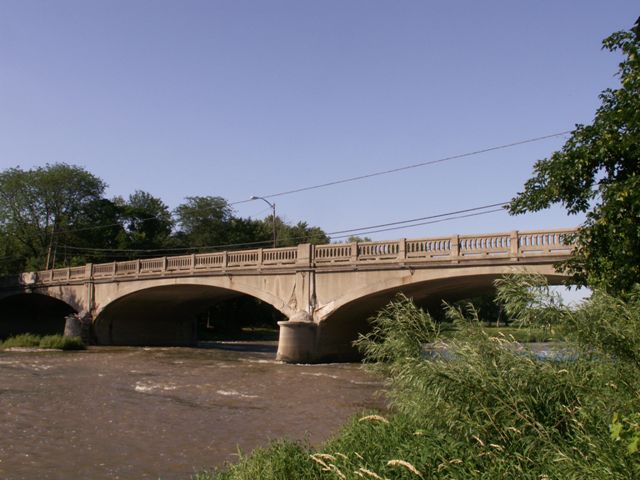
Toledo Street (OH-51) Over Portage River Elmore: Ottawa County, Ohio Concrete Closed Spandrel Deck Arch, Fixed 1926 By Builder/Contractor: D. H. Overman
Technical Facts
Main Span Length Structure Length Roadway Width Main Spans NBI Number
76 Feet (23.2 Meters) 282.2 Feet (86 Meters) 30 Feet (9.1 Meters) 2 6201202

Historic Significance Rating (HSR)

View Archived National Bridge Inventory Report - Has Additional Details and Evaluation

This bridge is a highly attractive, traditionally composed arch bridge. It retains original, unaltered railings. The bridge shows evidence of minor to moderate spalling. The time to preserve this bridge is now before structural and historic integrity is lost due to spalling. This is a preservation feasible and worthy structure in a county with relatively few historic bridges. The bridge is listed on the National Register of Historic Places.

Information and Findings From Ohio's Historic Bridge Inventory

Setting/Context

The bridge carries a 2 lane street over a stream in Elmore.

Physical Description

The 3 span, 282'-long, reinforced-concrete arch bridge is finished with concrete balustrades. There are plain pilasters at the piers and the spandrel walls are plainly finished except for a series of widely spaced dentils that repeat the pattern of the balustrade posts. There is loss of fabric from spalling in the balustrades, spandrels, arch rings, and substructure.

Integrity

Loss of original fabric from spalling.

Summary of Significance

The 1926 arch bridge is NR-listed (1994). Although somewhat formulaic in its aesthetic details, it is one of the first significant arch bridges attributable to D. H. Overman, who would go on to become the state highway department's arch expert and head design engineer. As such, the bridge marks the start of a distinguished career with the state highway department.

The 2007-08 ODOT Historic Bridge Inventory Update (Phase 1A) has identified more than 225 extant, reinforced-concrete, closed-spandrel arch bridges dating from 1896 to 1959. Fewer than 30 examples date to before 1910. These tend to represent innovative technology or early attempts at exploring the aesthetic qualities of the moldable material; earlier examples tend to have higher historical and technological significance than the later examples. Use of the reinforced-concrete, closed-spandrel arch technology reached its height during the 1910s and 1920s with more than 80% of Ohio's surviving examples dating from those two decades. The later examples generally do not represent innovative technology, although they sometimes have high aesthetic merit or significant settings/contexts.

"Closed spandrel arch bridges are the most basic of reinforced concrete bridge types. Closed spandrel means that the area between the deck and the arch ring was filled in. The spandrel wall actually serves as a retaining wall in the bridge, holding the fill material. Live loads are borne by the fill material and by the spandrel walls. The arch may be constructed either as a single structural element (barrel) or in separate parallel longitudinal ribs. The barrel arch design has some structural and visual similarities to stone arch bridges. The barrel arch is also sometimes faced with brick or stone, making it appear similar to a masonry arch bridge. This type of bridge is suitable for short span lengths. Closed spandrel concrete arches predate open spandrels, as the closed spandrel type harkens back to the stone arches that the earliest forms imitated. This type was not built for long as engineers realized that significant material could be saved and a reduction in weight could be achieved by eliminating the filled section. Hence, open spandrels were born. Filled spandrel concrete arches date primarily from the earliest decades of reinforced concrete (1890s through 1920s). They are not as common as many of the standardized bridge types built during this same era, such as concrete slabs and girders. They are significant because they are not common and represent the evolution of concrete technology. To be considered significant, filled spandrel arches should have integrity, through the retention of their character-defining features: arch ring, barrel, spandrel wall, railing or parapet, end posts, piers and/or abutments and wingwalls." [From: A Context for Common Historic Bridge Types by Parsons Brinckerhoff, October 2005]

Justification

The bridge is one of over 210 extant examples built in the state starting in 1897. It was during the first decade of the 20th century that the bridge type gained currency, and in Ohio the golden age of reinforced concrete arches was the two decades following World War I when over 140 of the remaining examples were constructed by cities, counties, and the bridge division of the state highway department under the leadership of J.R. Burkey and D. H. Overman.

Bridge Considered Historic By Survey: Yes

Divider

Photos and Videos: Elmore Bridge

Available Photo Galleries and Videos

Click on a thumbnail or gallery name below to visit that particular photo gallery. If videos are available, click on a video name to view and/or download that particular video.

 
View Photo Gallery Bridge Photo-Documentation
Original / Full Size Photos
A collection of overview and detail photos. For the best visual immersion and full detail, or for use as a desktop background, this gallery presents the photos for this bridge in the original digital camera resolution.
View Photo Gallery Bridge Photo-Documentation
Mobile Optimized Gallery
A collection of overview and detail photos. View the photos for this bridge in a reduced size which is useful for mobile/smartphone users, modem (dial-up) users, or those who do not wish to wait for the longer download times of the full-size photos. Alternatively, view this photo gallery using a popup slideshow viewer (great for mobile users) by clicking the link below.
Browse Gallery With Popup Viewer

View and Link
To Maps

Divider
 
Home Top

Divider

About Contact Footer

© Copyright 2003-2013, HistoricBridges.org. All Rights Reserved. Disclaimer: HistoricBridges.org is a volunteer group of private citizens. HistoricBridges.org is NOT a government agency, does not represent or work with any governmental agencies, nor is it in any way associated with any government agency or any non-profit organization. While we strive for accuracy in our factual content, HistoricBridges.org offers no guarantee of accuracy. Information is provided "as is" without warranty of any kind, either expressed or implied. Information could include technical inaccuracies or errors of omission. Opinions and commentary are the opinions of the respective HistoricBridges.org member who made them and do not necessarily represent the views of anyone else, including any outside photographers whose images may appear on the page in which the commentary appears. HistoricBridges.org does not bear any responsibility for any consequences resulting from the use of this or any other HistoricBridges.org information. Owners of bridges have the responsibility of correctly following all applicable laws, rules, and regulations, regardless of any HistoricBridges.org information.