



View Information About HSR Ratings
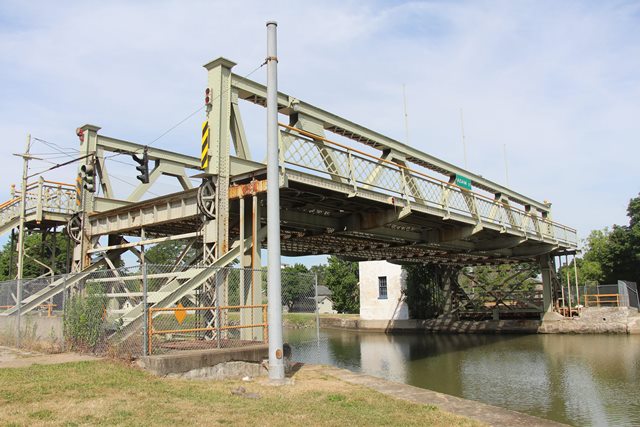
Except for the bridge tenders house, this just looks like an innocent pony truss with unusual vertical end posts. However when the Erie Canal tour boat comes up to this bridge, the whole bridge rises like a Phoenix, right of out of the ground! This bridge is a good example of one of the Erie Canal's highly unusual vertical lift bridges. While there are several surviving examples of this design on the Erie Canal, elsewhere the design is essentially nonexistent. Thus, each surviving example on the Erie Canal is significant. The bridge superstructure is a Warren pony truss bridge riveted connections. The end posts of the bridge are vertical, and extend below the deck as legs with a rack attached that is engaged by a pinion, allowing the legs to rise up, lifting the bridge. There is no v-lacing on the bridge's built-up beams. Lattice is present under the built-up top chords. The road deck is metal grate, and the sidewalks are wood, which is painted red. Old bricks form a roadway just before the bridge. Finding the one plaque remaining on the bridge required peeking behind a hazard sign which was rudely blocking the view of the plaque. The plaque identifies the Lackawanna Bridge Company of Buffalo, NY with building the bridge in 1917. Original railings remain on the cantilevered pedestrian sidewalks. There are stairs at each end which allow pedestrians to cross the bridge even when it it is raised, a typical detail of the Erie Canal lift bridges.
This bridge is one of the least altered examples of the Erie Canal lift bridges, but it also one of the most deteriorated. This bridge deserves to be rehabilitated for continued vehicular use, but its future is uncertain. The local community appears to support preservation, but it remains to be seen what NYSDOT, the owner, will decide to do.

The Erie Canal is one of the most famous and historically significant canals in the United States. Aside from the widely recognized historical significance of the canal as a transportation facility itself, a lesser known fact is that the canal is historically significant for the bridges that have spanned the canal over the years. It was here on the Erie Canal where Squire Whipple found a place to successfully get his "Whipple Arch" bowstring truss bridges constructed in significant quantities in the mid-1800s. The success of his Whipple Arch bridges helped contribute to the nationwide transition from wooden bridges to metal bridges. The period of time from 1905-1918 where the Erie Canal was upgraded and widened to become part of the larger New York State Barge Canal was a time of change for the bridges of the canal. Between the process of widening and upgrading the canal, and the nationwide trend to build more substantial bridges in the early 20th Century, the previous generation of bridges (many undoubtedly those Whipple Arch bridges) were replaced by a series of new bridges. These bridges have proved to be very durable and thanks to a clear commitment to preservation on the part of New York State Department of Transportation and other agencies, the Erie Canal and the New York State Barge Canal system, particularly the western section from Lockport to Spencerport boasts one of the highest densities of historic bridges of any waterway in the country. The vast majority of bridges on this section are maintained in beautiful condition.
Although the new bridges from the early 20th Century took a variety of forms, two forms were by far the most common. In rural or spacious areas, a fixed double-intersection Warren through truss was used, with a dirt approach providing the modest elevation needed for a fixed bridge over the canal. Double-intersection Warren truss bridges are generally considered an uncommon truss type on a nationwide basis. In urban and less spacious areas, a vertical lift bridge was used. The vertical lift bridges are an unusual design. Instead of towers that rise above the bridge in a traditional vertical lift bridge and pull the truss span up using cables, these bridges have vertical endposts which extend below the deck and into the ground. When operated, these extended endposts (called the lifting frame) rise out of the ground. In an engineering sense, these unusual vertical lift bridges might be thought of as bedstead truss bridges. Another unique feature of these lift bridges are the stairways found at each end of the bridge on the sidewalks. These stairways allow pedestrians to continue to cross the bridge when the structure is in the raised position. These vertical lift bridges continue to operate for boats today, so observing these unique bridges remains possible.
Elsewhere, the New York State Barge Canal System boasts other types of historically significant bridges.
View National Register of Historic Places Nomination Form for the New York State Barge Canal (Alternate ZIP Version In Sections) - Note this impressive document contains modern color photos of the bridges, some from unique angles, historical photos showing bridge construction, and original plan sheets for some bridges too.
View a HistoricBridges.org photo gallery of the historical photos, modern photos, and original plans contained in the National Register Nomination. This photo gallery can also be found in the Fairport Bridge's page.
View Historic American Engineering Record (HAER) Overview of Erie Canal Locks at Lockport, NY (Data Pages)
View Historic American Engineering Record (HAER) Index - Has a list of structures including bridges that were individually documented for HAER.
Erie Canalway National Heritage Corridor
Annual Reports on the New York State Barge Canal (Order By Fiscal Years): 1908, 1909, 1910, 1911, 1912, 1913, 1914, 1915, 1916, 1917, 1918, 1919, 1920, 1921
Story of the New York State Canals (1916)
New York State Barge Canal (1915 Overview of Project)
This bridge is tagged with the following special condition(s): Unorganized Photos


Coordinates (Latitude, Longitude):
Search For Additional Bridge Listings:
Bridgehunter.com: View listed bridges within 0.5 miles (0.8 kilometers) of this bridge.
Bridgehunter.com: View listed bridges within 10 miles (16 kilometers) of this bridge.
Additional Maps:
Google Streetview (If Available)
GeoHack (Additional Links and Coordinates)
Apple Maps (Via DuckDuckGo Search)
Apple Maps (Apple devices only)
Android: Open Location In Your Map or GPS App
Flickr Gallery (Find Nearby Photos)
Wikimedia Commons (Find Nearby Photos)
Directions Via Sygic For Android
Directions Via Sygic For iOS and Android Dolphin Browser
USGS National Map (United States Only)
Historical USGS Topo Maps (United States Only)
Historic Aerials (United States Only)
CalTopo Maps (United States Only)

© Copyright 2003-2024, HistoricBridges.org. All Rights Reserved. Disclaimer: HistoricBridges.org is a volunteer group of private citizens. HistoricBridges.org is NOT a government agency, does not represent or work with any governmental agencies, nor is it in any way associated with any government agency or any non-profit organization. While we strive for accuracy in our factual content, HistoricBridges.org offers no guarantee of accuracy. Information is provided "as is" without warranty of any kind, either expressed or implied. Information could include technical inaccuracies or errors of omission. Opinions and commentary are the opinions of the respective HistoricBridges.org member who made them and do not necessarily represent the views of anyone else, including any outside photographers whose images may appear on the page in which the commentary appears. HistoricBridges.org does not bear any responsibility for any consequences resulting from the use of this or any other HistoricBridges.org information. Owners and users of bridges have the responsibility of correctly following all applicable laws, rules, and regulations, regardless of any HistoricBridges.org information.
