



View Information About HSR Ratings
Additional Information: Although many sources report a 1932 construction date for this bridge, further research into local newspapers indicated that the bridge opened to traffic on September 3, 1931. This research also found some interesting discussions. Apparantly, there was a plan around this same time to build a concrete cantilever arch bridge similar to the Belle Isle Bridge to connect the island to Canada as well. This obviously never happened.
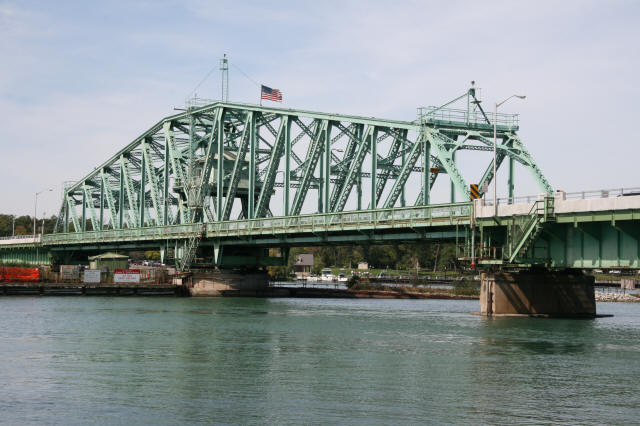
There are two bridges, both historic swing truss bridges, that provide motorists with access to Grosse Ile. The other bridge is the Grosse Ile Toll Bridge, which is privately owned and is funded through a small toll paid to cross the bridge. This bridge in contrast is owned by the Wayne County Road Commission, and does not cost anything to cross. As a result, the bridge is often referred to as the Free Bridge. As can be expected, this bridge is far more busy than the toll bridge. However, as a public bridge it is also subject to the flawed funding systems of transportation funding found in the federal, and state levels of American government that encourage deferred maintenance and discourage spending on repair and maintenance. Despite this, overall, the bridge has been maintained better than the average historic truss bridge. However, the bridge is not maintained in the same pristine condition as the Toll Bridge. One oddity with the Free Bridge is that in 2007 the deck was replaced. During this project the original railings on the swing span were replaced with modern Armco guardrails. The approach railings (not original) were also replaced. However, no painting was done to the truss. It may have not needed a complete blast cleaning and repainting, but the bridge definitely could benefit from a spot painting. Painting is one of the most important ways to prevent deterioration of a metal truss bridge.
This bridge is an impressive 1932 swing camelback through truss bridge with a Pratt configuration. 1930s truss bridges are extremely rare in Michigan, and so the massive members and two-lane nature are quite an unusual sight in Michigan. Extensive v-lacing and lattice is present on members and bracing. Original vehicle guardrails are lattice also, and until replaced in 2007 were unaltered. Pedestrian railings are Michigan State Highway Department standard railings, which were commonly seen on the 1930s truss bridges when they were built, and they are also unmodified. The bridge in New Boston also has this standard plan railing. The bridge has a bunch of deck plate girder approaches at each end. Multiple plaques on the bridge describe the various contractors involved with the bridge.
The steel for the bridge was fabricated by Duffin Iron Company of Chicago, Illinois. Rossen, Evans, and Rossen of Chicago, Illinois are noted as engineers on the shop drawings for the bridge.
Drone video showing the bridge operating for boats can be seen here.

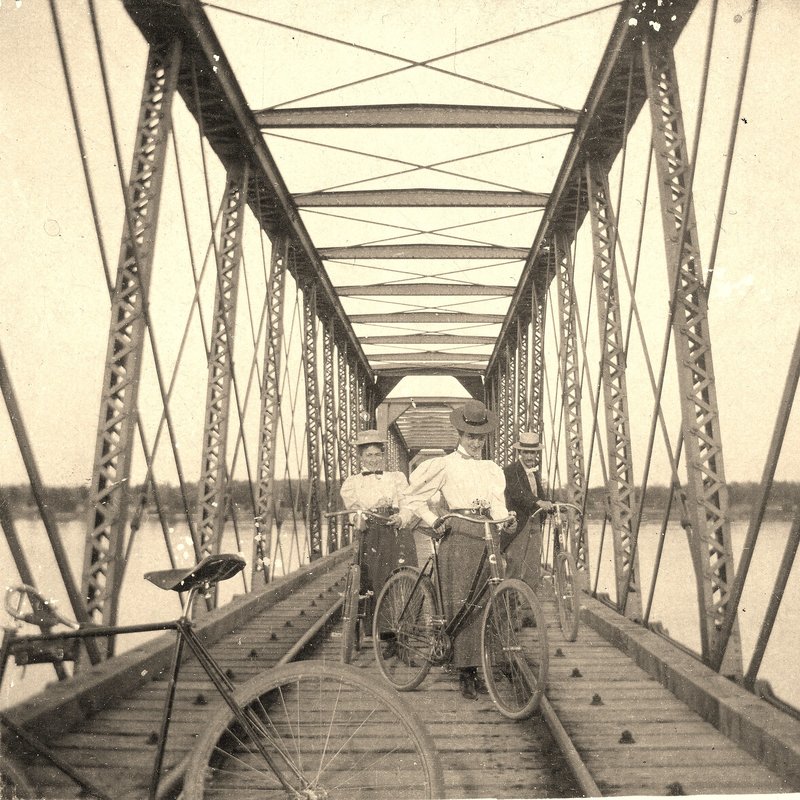
The previous bridge at this location was also a railroad truss bridge, but it was a iron Post truss. Even back when this previous bridge was replaced, it would have been an uncommon bridge as Post truss bridges were never very popular. A photo of the previous bridge is shown below, as is a drawing showing the previous bridge in the plans for the current bridge. When the current bridge was built, the old piers were reused, with additional piers added for the shorter approach spans of the current bridge. As of 2019, this history has proved troublesome as the older piers have begun to deteriorate. Drivers may notice the deck has "humps" as they drive over, since it appears the older pier may be slowly sinking. Additional controversy in recent years has arisen by the owner, Wayne County, failing to perform required inspections at the schedule required by law. As of 2019, a Design/Build project is being developed to address the deteriorating bridge's substructure. It remains unclear if the bridge's historic swing span truss, and/or its historic riveted deck plate girder approach spans are at risk for demolition. The trusses and girders themselves remain in good condition.

Information and Findings From Michigan Historic Bridge InventoryNarrative Description This bridge was the last through truss swing bridge to be constructed in Michigan. It has ten steel girder spans, each 118 feet long, and a single camelback through truss swing span 340 feet in length, yielding a total length of 1350 feet. This structure was originally built for the Michigan Central Railroad by Augustus J. Dupuis Company of Detroit. |



Coordinates (Latitude, Longitude):
Search For Additional Bridge Listings:
Bridgehunter.com: View listed bridges within 0.5 miles (0.8 kilometers) of this bridge.
Bridgehunter.com: View listed bridges within 10 miles (16 kilometers) of this bridge.
Additional Maps:
Google Streetview (If Available)
GeoHack (Additional Links and Coordinates)
Apple Maps (Via DuckDuckGo Search)
Apple Maps (Apple devices only)
Android: Open Location In Your Map or GPS App
Flickr Gallery (Find Nearby Photos)
Wikimedia Commons (Find Nearby Photos)
Directions Via Sygic For Android
Directions Via Sygic For iOS and Android Dolphin Browser
USGS National Map (United States Only)
Historical USGS Topo Maps (United States Only)
Historic Aerials (United States Only)
CalTopo Maps (United States Only)

© Copyright 2003-2024, HistoricBridges.org. All Rights Reserved. Disclaimer: HistoricBridges.org is a volunteer group of private citizens. HistoricBridges.org is NOT a government agency, does not represent or work with any governmental agencies, nor is it in any way associated with any government agency or any non-profit organization. While we strive for accuracy in our factual content, HistoricBridges.org offers no guarantee of accuracy. Information is provided "as is" without warranty of any kind, either expressed or implied. Information could include technical inaccuracies or errors of omission. Opinions and commentary are the opinions of the respective HistoricBridges.org member who made them and do not necessarily represent the views of anyone else, including any outside photographers whose images may appear on the page in which the commentary appears. HistoricBridges.org does not bear any responsibility for any consequences resulting from the use of this or any other HistoricBridges.org information. Owners and users of bridges have the responsibility of correctly following all applicable laws, rules, and regulations, regardless of any HistoricBridges.org information.
