


|
|
Address for Daniel Alwards Page For This Historic Page:
http://www.venangoil.com/bridgesshanleyrd.html
Address for Daniel Alward's Page Discussing This and Two Nearby Historic Bridges:
http://www.venangoil.com/bridgesspringcreektrio.html
Address for Lehman Engineer's Page For The Replacement Project:
http://www.lehmanengineers.com/Elk_County_Bridges.htm
|
Key Facts |
Bridge Name |
Type | Road | Location | City | Crossing |
| Shanley Road
Bridge "Maxwell Run Bridge" | Truss | Shanley Road (T-308) | Elk County, PA | Rural (Near Hallton) | Clarion River |
The only thing that Pennsylvania and Preservation have in common is the same first letter!
The Shanley Road Bridge was known as the Maxwell Run Bridge locally, because of the nearby Maxwell Run that empties into Clarion River near the bridge. The bridge was a four span through and pony truss bridge. It featured two Pratt through main spans, with an approach pony truss span at each end. I was unsure what truss configuration to place these approach spans in, but the surveyors list it as a Howe configuration. The bridge was built in 1891, and in 1905 the approach spans were replaced with the ones present when the bridge was demolished. The builder of the bridge was the Pittsburg Bridge Company's agents, Nelson and Buchannan, of Chambersburg, Pennsylvania. The steel for the 1905 approach spans were fabricated by Carnegie steel. The deck of the bridge was wood, and was 12.5 feet wide. Their was 14.3 feet of vertical clearance on the bridge. The approach spans were 50 and 55 feet in length. The main spans were each 115 feet long. This yields a total of 335 feet in length for the bridge. The bridge was posted at a three ton weight limit. When PennDOT and Elk county sought replacement of the bridge, they publically offered the truss bridge to anyone willing to pay the costs to move and rehabilitate the bridge at a different location. A number of inquiries were recieved, but no one actually decided to move the bridge. A replacement structure was built in 2004, 50 feet downstream from the location of the truss bridge. The truss bridge was demolished after the replacement structure was completed, during the first week of November.
This Pratt truss bridge, built in 1891, was in my humble opinion the greatest truss bridge I have ever seen and probably ever will see. I have seen numerous truss bridges in Michigan and Pennsylvania and none even come close to this bridge. What made this bridge great was not that it was a record breaker in a single category, rather, it simply exhibited great qualities in all categories. I am sure that no other truss bridge has so many positive aspects. Whoever gave the order to tear this bridge down is committed a horrific sin against society and history. Sometimes I can see why a road commission would want to destroy a historic bridge, however I can not here. There was not a single reason to tear this bridge down, and there was every reason to at least leave this bridge standing. The Shanley Road Bridge was known locally as the Maxwell Run Bridge. Hopefully, the crossing is now referred to as the Maxwell Run Slab.
The Shanley Road Bridge was demolished fifty feet away from the replacement bridge, and away from the new road alignment. It was not in the way at all. This is what makes the destruction of this bridge such a crime. There was no reason to destroy this bridge. I was told that the bridge was being demolished because leaving it standing the way it has for over a century is now a liability. Officials said that leaving the Shanley Road Bridge standing in its current condition closed to vehicular and pedestrian traffic was a liability because someone could get hurt on the bridge. This sounds like a decent reason, however, a survey was responded to by twenty-nine Departments of Transportation, and the findings were that none had ever been sued for an injury involving a historic bridge, although fifteen felt that liability was a reason to not preserve a bridge. The project that included this survey can be viewed at www.srifoundation.com. Moreover, in Michigan there must be hundreds of historic bridges that are closed to traffic and are left to rot away. No one complains about liability in Michigan, and nobody has a problem with leaving them standing if they are not in the way.
This angers me because it feels like a violation of my rights. There are two groups of people who could take sides with the Shanley Road Bridge. One group that wanted a replacement bridge, and another that wanted to leave the old bridge standing. Because the new bridge was built away from the old bridge, both groups could have had their way if they left the old bridge standing, even un-restored. Yet as it turns out, the replacement group of people got what they wanted, and the historic bridge community got nothing. I feel that was unfair, given the circumstances.
One of the things that set this bridge ahead of most truss bridges was the number of spans. Most truss remaining turn-of-the-century truss bridges do not have four spans! Also, most truss bridges are either through or pony in design. This bridge was both! This bridge was a great example of a pony truss and a through truss - two times. Also, this bridge was both a good example of pined connections and riveted connections. The pony truss spans' connections were riveted, while the through spans' connections were pinned.
The surveyors who evaluated historic bridges in Pennsylvania said in their report about this bridge that "The bridge is historically and technologically significant as a complete example of an increasingly rare type and design." That really does sum up what made this bridge important. This is where this bridge hit the money. Simply put, this bridge appeared to retain complete historic integrity. Although the pony truss spans showed a 1905 construction date, suggesting they were rebuilt, the alteration itself was old enough to be historic. The deck was wood, and appeared to be built in the way it would have been originally. The lattice guardrails remained on the whole length of the bridge. No damage appeared to have been done to the guardrails, which was a miracle. Plaques remained on both the pony and through spans of the bridge. The abutments and piers were all of the ashlar cut stone design.
This bridge was considered significant to the surveyors who evaluated historic bridges in Pennsylvania. They mentioned in their report that "Adding to its significance is its documentation to the Pittsburgh Bridge Company and its agents, Nelson & Buchanan Company, regionally prominent and prolific fabricators of highway bridges in the late 19th and early 20th centuries." I am unsure why Pennsylvania even bothered to spend the money to hire the historic bridge surveyors; the bridges deemed significant are not treated any differently than those which are not. If the county did not have the money to restore the bridge, it should have been PennDOT's responsibility to do so.
I also would like to reiterate that the through spans were built in 1891. Consider what life was like in 1891, and perhaps you can see why I have such respect for a bridge like this. There were no cars when this bridge was built. There were no bulldozers, diesel cranes, and all of the things that are used on construction projects today. There was no semi truck to haul in the i-beams for this bridge. Expressways were not even conceived yet. It is possible that steam powered boats brought in a lot of the materials, I am not sure. A lot of people back then put a lot of manual labor into making this bridge. This bridge was built back when there were not all the safety procedures that we have today as well. Back in 1891, working construction could be a very dangerous, and sometimes lethal job. It would been a nice tribute to these hard-working people to preserve this bridge. I would be interested to know how long it took to build this bridge. I am certain however, that a lot more work and time to build this bridge than the single week that it took to destroy it.
For a bridge of this age, I feel that it was in fine condition. The two through spans were built in 1891 and stood for 113 years, well over a century. It would most likely have continued to stand as it was for decades as a pedestrian crossing. On the other hand, the bridge was in a condition that made it suitable for restoration. Anyone who feels that this bridge was in bad condition at the time of its destruction should take a trip to Michigan and see how awful Michigan truss bridges are when they are completely restored. Don't let PennDOT or Elk County fool you - this bridge was clearly in restorable condition.
I wish that those who applauded the demolition of this bridge could stop and think for a moment. I wish they could look at this bridge and pretend to be a historic bridge enthusiast for just a moment. Perhaps then they would see why the bridge was worth saving. For someone who likes historic bridges this bridge was breathtaking. This bridge just has an attractive appearance to it. It is hard to describe in technical terms what makes a bridge beautiful, but I can give it a shot. The cut stone piers are one specific thing. Also, with the small pony spans nearest the shore and the main through spans in the middle, this bridge had a nice overall shape to it when viewed from a distance. As with any truss bridge, the intricate geometric patterns added to the beauty of the bridge. I personally am a fan of bridges with lattice and v-lacing on them. This bridge had v-lacing on just about every member that a bridge of this era would have. There was even v-lacing under the top chord on the through spans. Finally, I have to say that the silver-grey paint that was on the bridge looked very attractive. I am unsure if that was the original paint color, but I liked it either way.
This particular bridge page stands to document the Shanley Road Bridge like any other bridge. However, it exists for another, more important reason. I feel what has happened to this bridge is wrong, and I feel that it is unfair. I want to document the bridge, I also want to document the conditions under which the bridge was destroyed. Because the new bridge was built away from the historic bridge, the historic bridge should have been left standing. Sure, not everyone cares about historic bridges, but some people do. Building a new bridge would satisfy those who simply see a bridge as a way to get across a river, and leaving the old bridge standing would satisfy those who see a truss bridge as a beautiful historic landmark. As the bridge is demolished, I am left wondering where my rights are. Sure people have a right to get across a river safely and efficiently. But what about my right to visit and enjoy a beautiful bridge that is is not in anyone's way? I guess that's a right that the people in charge feel I don't deserve.
Simply left standing as is with no repairs, this bridge could likely have stood for decades as a pedestrian crossing. Demolishing the bridge cost money and deprived the world of a historic bridge. Leaving the bridge would have cost nothing. On reason for demolishing this bridge was the fear of being sued if someone got injured on the old bridge. Statistics show that there is not a history of people suing DOTs and road commissions over a historic bridge injury. I got that information from a report at www.srifoundation.com.
Another flaw is in the way money moves from the Federal level to the local level. Both in Pennsylvania and here where I live, in Michigan, local road commissions receive money from the Federal Government to demolish and build new bridges, but not to maintain or restore existing bridges. This also means that road commissions will not care for their bridges properly, and instead let them decay until they are bad enough that they can claim them as a Critical Bridge. Then, county road commissions will usually opt to demolish and build a new bridge, even though it is usually more costly in terms of raw money. After all, it is not their money they are spending, it is federal money. But the fact is that it is tax-payer money. No matter what level of government it comes from, it is our money, and it is being wasted on demolishing bridges that could be restored for less money. Whatever laws are causing this to happen need to change.
This is a crossing over the Clarion River, a river designated a National Scenic River, and I was told that having two bridges, the truss bridge and the new bridge, at the same location would have violated the rules for Scenic River Act rivers. Whoever set those rules probably did not even consider a situation like the Shanley Road Bridge. But the inflexibility of the law apparently did not allow for an exception. The fact is, a large number of trees and scenery were destroyed in the name of the new bridge, and affected the scenery on the river much more than the truss bridge ever did. Besides, the historic bridge was so old, that in my opinion it was part of the scenic river. Moreover, the removal of the bridge destroyed a fair amount of life as well. Look at the picture of the bridge on this page and see how many plants called the Shanley Road Bridge their home. I should also point out that birds often nest inside the top chords of through truss bridges. I know this because I watched a Robin feeding babies in a nest on the Church Road Bridge on the same day the bridge was demolished. It was heartbreaking to watch the bird land on a part of the top chord of the bridge looking for its baby-filled nest after the bridge was knocked into the river. So I am sure both the Church Road Bridge and the Shanley Road Bridge could actually be considered a habitat for animals and plants near the Clarion River.
As can be expected, I am completely disgusted with the replacement bridge. You can find a picture of the horrific structure leaving a distasteful stain on the first page of this document.
I have several reasons to hate the new bridge. In the nearby area, another truss bridge, on Arroyo Road was also demolished. This bridge was a three span bridge and looked quite different than the Shanley Road Bridge. On the Lehman Engineers Website, at www.lehmanengineers.com a single artist's picture on the Elk County Bridges page represents the replacement bridge for both Shanley and Arroyo roads. That spells out my first problem. New bridges all tend to look alike, and these two are so similar that a single picture can represent them both. You could not get away with that with the truss bridges. There is beauty and interest in variety, and that has been taken away from this area. Anyone who says the replacement crossings are safer should consider that people are going to fall asleep at the wheel driving through this now-bland area of roadway.
The other thing that really irritates me is the way they presented the new bridge. The designers did not just say that it is a new bridge, ugly yes, but in their minds safer and more efficient. Instead, they dared to compare the bridge to the Shanley Road Bridge, and cited things on their slab of steel that supposedly make the bridge attractive like Shanley Road. In my opinion, there is no comparison. It is rude to even suggest that the two bridges have anything in common. Take the abutments and piers of the new bridge for example. The engineers claim that they look like the old bridge piers, because they cast a cut stone design into the concrete. Take a look on my photo gallery and see what you think. In my opinion, they look completely different, and the new ones look dumb, especially with the red pipe running down it. Also, the fact that this casting into the concrete on the new bridge on Shanley Road looks exactly like a design cast into the abutments of a new expressway overpass near where I live in Michigan also irritates me. I would be happier if they had just made the new bridge a total concrete slab, instead of trying to cover up the truth with these fake decorations that mock the beauty and historic integrity of the original bridge.
The engineers chose metal guardrails instead of New Jersey Barriers, and steel i-beams as opposed to concrete for the bridge, to give motorists an opportunity to enjoy the view of the river. Good thing they did that, since there is nothing else to enjoy. Certainly the new bridge does not warrant any attention, and there is no historic bridge to enjoy.
Now that the Shanley Road Bridge is gone forever, it is time to see if us historic bridge lovers can have the last laugh or not. I personally do not think that the new crossing will stand for 113 years.
This historic bridge was demolished. The maps are shown for reference purposes only.

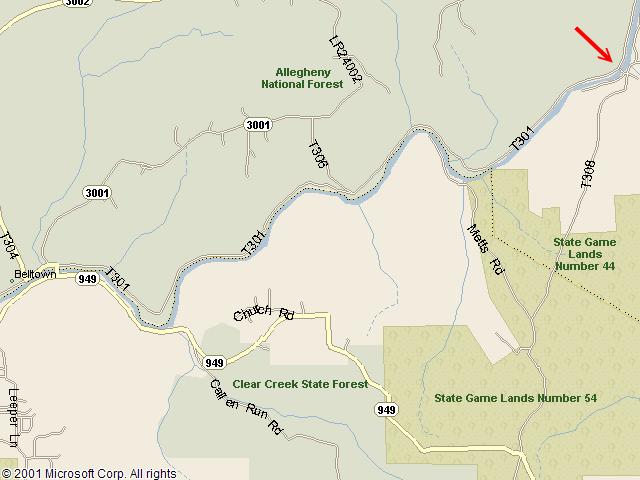
This historic bridge was demolished. This map is shown for reference purposes only.


