


January 2006: Wallace Road Bridge
 |
This Washtenaw County Road Commission told me that the Wallace Road Bridge is non-historic, and they currently plan to demolish this quaint pony truss, situated in a scenic rural landscape over the River Raisin, as part of the nearby Wilbur Road Bridge's replacement. This non-historic assessment is obviously outdated. I am certain that a 2006 historic bridge inventory would find that this and any other surviving truss bridge is historic, due to the shear decrease in remaining truss bridges since the last 1995 survey. The atrocity however, is that the county does not plan to build a new bridge here; they are going to abandon the crossing! Why deprive people of a beautiful historic bridge, and waste taxpayer dollars, if no new bridge is ever planned?! At the very least, the bridge should be left as is, since it would likely stand for decades as it is now. However, I am sure a restoration of such a small bridge, especially for pedestrians only, would not be costly. Why not instead preserve one of our state's unique treasures? |
February 2006: 1/2 Mile Road Bridge
 |
This fascinating through truss is located in extreme southwestern Calhoun County, and is closed to traffic. The road it is on is known as Maul Lake Road in nearby Branch County. Failing abutments, which are tipping inward to the river, have put this bridge at risk. Fortunately, Calhoun County's Historic Bridge Park plans to move this bridge to the park. This is excellent news, as it means this small through truss will be preserved for future generations to enjoy. Finding a through truss that is this short in Michigan is a bit unusual, so this bridge is significant on that account. If you are in the area, I recommend visiting this bridge before it is moved so that you can experience the bridge in its original location. The bridge currently sits in an area that allows the bridge to be easily photographed. I will post news when plans to actually move this bridge materialize. |
March 2006: Speaker Road Bridge
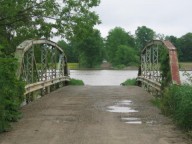 |
Plans are to dismantle and relocate this St. Clair County bridge to Calhoun County's Historic Bridge Park. As a pin connected Parker pony truss, this bridge is an example of a bridge type that is extremely rare in Michigan. With it destined for the bridge park, this bridge will not have to face demolition, but on the other hand it is unfortunate that this bridge could not be restored for light vehicular traffic where it stands so St. Clair County residents can enjoy this bridge easily and in its original environment. The road it is on is lightly traveled and even floods over during the spring, rendering the road unusable at times, as shown in the above photo. Poorly designed road and bridge policies are largely responsible for the replacement of bridges on roads of questionable importance. Certainly if this bridge were restored enough to maintain its 3 ton weight limit, this would be sufficient to serve the largely residential traffic on the road. An alternative crossing is available less than a half mile south of this bridge for heavier traffic that cannot cross this bridge. |
April 2006: McKeowen Road Bridge
 |
Also known as the Sponable Bridge, this is the last remaining truss bridge in Barry County, Michigan. Crossing the Thornapple River, it is a classic pin connected through truss bridge, representative of a once-common type of bridge that was built around the turn of the 20th century. The pin connected through truss has become increasingly rare due to attrition, making what would have been considered a common bridge at one time, a rare, beautiful landmark. Barry County officials recognized the significance of this bridge when they preserved it in its original location for pedestrian use and created a park around it. A modern concrete structure provides a vehicular crossing to the west of this bridge. The McKeowen Road Bridge is an example of a success story, where a solid compromise between safety and efficiency on roadways and the preservation of a truss bridge was also accomplished. As a bonus, an attractive park was created for the enjoyment of residents. The McKeowen Road Bridge should serve as an example for other counties and states to follow. |
May 2006: CR-175 North Bridge
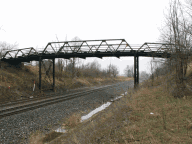 |
Located in Butler County, Indiana, this bridge is one a a few unusual truss bridges in the county that carry highway over railroad. This bridge is the largest of them, and the most impressive in appearance. The wooden deck, v-laced truss members, and the inclined approach spans create a structure that is both beautiful and has a distinct feeling of a past era to it. The bridge is significant as a multi-span pony truss also. The bridge is open to vehicular traffic, but has not been maintained for some time. Considering the low volume of traffic this bridge carries, and the historic and aesthetic value of the structure, this bridge should be preserved for light vehicular traffic. This bridge also symbolizes an change for this website. As an non-Michigan bridge, and as a bridge type that does not exist in Michigan, it represents a change that is coming to this website, as my coverage expands beyond Michigan to include the fascinating bridges in places such as Ohio and Indiana. The CR-175 Bridge represents the sort of fascinating bridges that can only be found outside of Michigan, and suggests the wider variety of bridges that I intend to feature on this website by Fall 2006. |
June 2006: Blue Rock Road Bridge
 |
Located in Hamilton County, Ohio, this breathtaking bridge is unlike anything I have ever seen before. Its sweeping arch shape, complex Pennsylvania truss configuration, and extensive v-lacing and lattice combine to form a structure that is unparalleled in majesty. As unbelievable as it may be Hamilton County intends to demolish this bridge this summer of 2006, in an act of unspeakable senselessness. It is bad enough to destroy this beautiful structure, but even worse, the replacement structure is completed a quarter mile away from this bridge! This bridge is not in the way of anything and should be allowed to remain standing. It will cost Hamilton County $200,000 of taxpayer money to obliterate this bridge. Hamilton County told me they must demolish it because of "advanced structural deterioration" which although they wouldn't admit it, I know it could be corrected, and also some FEMA flood level thing. I am sure this FEMA thing could be bypassed if they really wanted to save the bridge. For instance, if FEMA declared this for the Brooklyn Bridge in New York City, I doubt that bridge would really be demolished. |
July 2006: Caldwell Bridge
 |
Located in Butler County, Pennsylvania on Hoon Road, I was able to visit this bridge a mere two weeks before its posted July 10th demolition date. Constructed in 1902, it is an early example of a Pratt pony truss featuring riveted connections. According to Pennsylvania's rather conservative historic bridge inventory, it is listed as "...One of nine riveted Pratt pony truss bridges from the early 20th century remaining in Butler County, is historically and technologically significant as an early, complete example of its technology. It represents the transition from pinned to riveted field connections in highway applications." I am unsure of why this historic bridge inventory was done, if its findings do not affect whether historic bridges are demolished. This clearly was a historic bridge, to say nothing of the aesthetic value it adds to its road. It certainly didn't stop the bridge from being demolished! Pennsylvania like to demolish truss bridges, from small pony trusses like this to large cantilever bridges over the Ohio River. As I always say, the only thing that "Pennsylvania" and "Preservation" have in common is the same first letter! |
August 2006: Old Goulais Bay Road Bridge
 |
Located in northern Ontario, a bit north of
Sault Ste. Marie, this is an impressive two-span Bailey truss
bridge. The Bailey truss was developed during World War II as a
type of bridge that could be built quickly, and adjusted quickly
for different span lengths and load requirements. Bailey bridges
continue to be built today in some cases, and they look very
similar to the older examples. This bridge appears to be
genuinely historic, featuring 1944 stamps on the steel. A Bailey
bridge couldn't be much older than this. The bridge may even
have been war surplus. The fate of this historic bridge has
recently come into question. Sometime between May and July, the
bridge was closed to traffic, due to the pier visibly sinking at
the south end, slowly twisting the bridge structure. The bridge
has been closed to all traffic as a result. It is my hope that
the bridge will be lifted off the pier, so the pier can be
replaced and the trusses can be restored, and placed back over
the Goulais River. Click here to visit the page for the Old Goulais Bay Road Bridge. |
September 2006: North Avenue Bridge (Demolition)
 |
Chicago is known by bridge enthusiasts as the bascule bridge capital of the world. For the most part, Chicago has done a good job maintaining their movable bridges, even if their movable function is no longer needed. Despite this, the City of Chicago has now shown that they are not afraid to wipe this important part of the unique city's identity off the face of the earth with the demolition of the North Avenue Bridge this month, according to Chicago DOT's website, and raises some worrisome questions about many of the other bridges in the city. Ignoring an opportunity to construct a second two-lane bridge next to this bridge to form a four-lane crossing as a one-way couplet of bridges, Chicago has elected to build a weird cable-stayed/suspension bridge that looks absurd on a small river of this size, and also does not blend in with the other historic bridges that continue to speak of Chicago's rich history and present-day culture and identity. This bridge was among the oldest of Chicago's bridges, with a 1907 construction date. The loss of this bridge takes away a significant part of what makes Chicago special and a unique city to visit and enjoy. There is something special about seeing the third largest city in the U.S. literally bound together by a network of historic bridges that continue carry 21st century traffic. My only hope is the demolition of this bridge will serve to raise awareness for the remaining bridges, which I would like to see instead preserved. I know a great city like Chicago is better than a city that goes around demolishing historic bridges! I hope to never have to put an "X" next to a Chicago bridge again! Only time will tell. |
October 2006: Bostick Road Bridge
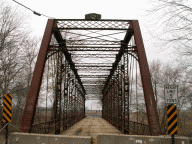 |
The Bostick Road Bridge is a bridge at risk. It was closed to traffic, and now Allen County plans to replace this breathtaking Whipple truss (also known as a double-intersection Pratt). Built in 1894, the bridge is a rare, documented example of the Canton Bridge Company of Canton, Ohio. It features a decorative portal and sway knee bracing. Some time ago a public meeting to discuss interests in the bridge was held, and officials considered the fact that most people's concern was just to have the crossing open to traffic again to mean that there was no issue with demolishing the bridge. However, a local meeting is only the first step to determining the value of this bridge. People like myself do not live near the bridge nor attend their local meetings, but yet it is important to preserve this bridge for the benefit of all citizens, not just those near the bridge and those using it as a commuter route to connect to the expressway. Allen County has a highly unusual concentration of Whipple truss bridges, which is an otherwise rare truss configuration, and has preserved a number of their other truss bridges. Some might suggest that Allen County has done their duty for history, but I suggest otherwise. Instead, I ask if these other bridges were preserved, why can this bridge not be preserved? The truss structure of the bridge is in fair condition, although the floor beams might need to be replaced. Yet there may be hope! Fort Wayne's local historic preservation group, ARCH appears to agree. They have convinced the county to dismantle and store the bridge for possible re-erection in a new location. There will likely be more news about this bridge in the future. Stay tuned. |
November 2006: Balls Bridge
 |
This is the second year that this website has recognized November as Historic Bridge Awareness Month. This year, no other bridge better represents the spirit of Historic Bridge Awareness Month than Balls Bridge over Maitland River in Huron County, Ontario. An an 1885 two span pin connected Pratt through truss, this is one of Ontario's most historically significant... and beautiful... metal truss bridges. It recently was closed to traffic due to structural deterioration, mostly because its owners had done little to maintain it over the past couple decades, citing a nearby modern bridge as being the only needed crossing. As a result, no plan to repair and reopen the bridge was made. But unlike so many bridges where this happens without anyone speaking out against it, a group of concerned citizens formed the Friends of Balls Bridge to work to save the bridge. A petition supporting the preservation of the bridge was created and as of November 1st, an impressive 872 signatures were on it. Well over 100 people attended a public forum on the bridge in October. Although the future of the bridge is still not certain, the group continues to make progress that is slowly, but steadily reducing that certainty and moving towards organizing a preservation project. The amazing community awareness and dedication to save the bridge seen with Balls Bridge presents a perfect example of the essence of Historic Bridge Awareness that is being promoted this month. |
Special November 2006 Event: Historic Bridge Awareness Month
November is Historic Bridge Awareness Month! - Click here to learn more about the events for this month, as well as a special project where your help is needed as the historic bridge community seeks to revise a piece of of transportation legislation!
December 2006: Interstate System's 50th Anniversary: 6th Street Bridge
 |
2006 marks the 50th anniversary for the
signing of the Federal-Aid Highway Act by President Eisenhower,
that provided funding for the Interstate System we know today.
Without the Interstate System, there would be far fewer bridges
present on this website, because it would take so much longer to
reach a destination. Some states, including Michigan, have a
number of limited-access highways that predate the Interstate
System, including I-94 (The Detroit-Chicago Expressway) and I-75
(The Detroit-Toledo Expressway). In Michigan, there are a number
of structures that have historic significance on the Interstate
Highway System. Some are steel stringer structures that offer
old age, or unusual design. Most notable of Michigan's
overpasses are the attractive curved t-beam structures, with
their graceful curves and attractive railings. And finally,
larger landmark bridges like the Mackinac Bridge are significant
as feats of engineering. Both large and small, all these bridges
are important to preserve because they provide attractive and
interesting scenery on a roadway type that, although efficient,
has often been criticized as plain and boring. They also are an
important part of the heritage of a system that is now half of a
century old, and are a significant part of the success of this
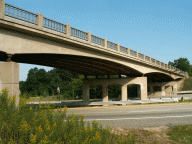
country's expressway system. Shown in the photo above is
Kalamazoo County's 6th Street Bridge. Below is a list of links
to some of the most notable expressway bridges in Michigan. 6th Street Bridge, Sigler Road Bridge, Mackinac Bridge, 38th Street Bridge, M-48 Bridge |

